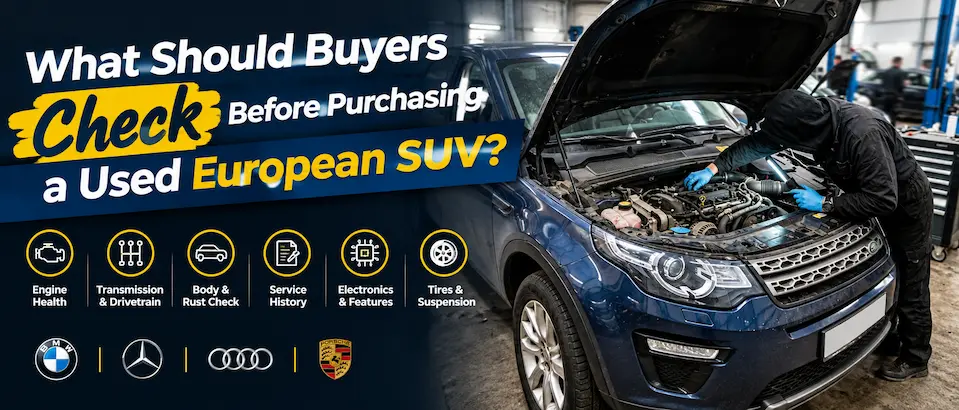
Buying a used European SUV can be exciting, especially when you want comfort, strong performance, and better features without paying the price of a new model. However, these vehicles can also have costly repair needs if they were not cared for properly.
Before buying, check the vehicle history, engine, transmission, suspension, brakes, electrical systems, cooling system, and service records.
A professional inspection can also find hidden faults that may not be clear during a short test drive. These checks can help buyers avoid unexpected repair bills and choose a safer, better-maintained SUV.
Complete Checklist Before Buying a Used European SUV
1. Check the Vehicle History and Service Records
A vehicle history is one of the first things a buyer should check. Look for records that show regular oil changes, brake work, transmission service, cooling system repairs, and other major jobs.
A well-maintained European SUV should have a clear service history rather than long gaps between visits to a workshop. Check if the vehicle has been involved in a major accident or has had repeated repairs.
Also compare the mileage shown on the dashboard with service records. A sudden change in mileage can be a warning sign that needs more investigation before you make an offer.
2. Inspect the Engine for Signs of Trouble
The engine should be checked carefully because engine repairs can be expensive on many European SUVs. Start the vehicle when the engine is cold and listen for unusual ticking, knocking, rattling, or rough sounds.
Check the exhaust for thick smoke and look under the vehicle for oil or coolant leaks. The engine bay should not have large amounts of fresh oil around seals or hoses.
During the drive, notice if the engine struggles to accelerate, loses power, or runs roughly. A warning light on the dashboard should never be ignored, even if the vehicle appears to drive normally.
3. Test the Automatic Transmission
Many European SUVs use advanced automatic transmissions that provide smooth and quick gear changes. However, these systems can be costly to repair when they develop faults.
During the test drive, check if the vehicle moves smoothly from a stop and changes gears without hard jolts, long delays, or strange noises. Try both gentle and stronger acceleration to see how the gearbox reacts. Reverse gear should also engage without a long pause.
If you notice slipping, shaking, or delayed engagement, have the transmission checked before buying. For added confidence, arrange a professional pre-purchase car inspection in Dubai before completing the deal.
4. Check the Suspension and Steering System
The suspension has a major effect on ride comfort, handling, and safety. European SUVs may have complex suspension systems, including adaptive dampers or air suspension, which can be expensive when parts fail.
During the inspection, look for uneven tyre wear, leaking shocks, damaged bushes, or a vehicle that sits lower on one side. On the road, listen for knocking sounds when passing over bumps. The steering should feel stable and should return smoothly after a turn.
If the SUV pulls to one side or the steering wheel shakes, the problem could involve alignment, suspension parts, tyres, or steering components.
5. Inspect the Brakes and Tyres
Brakes and tyres should never be treated as small details when buying a used SUV. Check the brake discs for deep grooves, heavy rust, or signs of uneven wear. During the test drive, the brake pedal should feel firm, and the vehicle should stop in a straight line.
Listen for grinding or squealing sounds. Tyres should have even tread across their surface, as uneven wear can point to suspension or alignment problems.
Also check the tyre age because old rubber can become hard even when the tread looks good. Replacing several tyres and brake parts can quickly increase the buying cost.
6. Test the Cooling System and Air Conditioning
A cooling system in poor condition can cause serious engine problems, so it deserves close attention. Check the coolant level and look for leaks around the radiator, hoses, expansion tank, and water pump area.
The engine should reach normal temperature without overheating. The air conditioning should also produce cold air without strange smells or unusual noises. Test the AC at different settings and check the blower at different speeds.
European SUVs often have complex climate systems, so a small fault may involve sensors, motors, or control units. A proper check can prevent expensive cooling and AC repairs later.
7. Test All Electrical and Electronic Features
Modern European SUVs can have many electrical features, including parking sensors, cameras, digital screens, heated seats, electric windows, keyless entry, and driver assistance systems.
Test every feature before buying rather than assuming everything works. Check the dashboard for warning lights after starting the engine. Make sure the infotainment screen responds correctly and that cameras and parking sensors work as expected.
Try the headlights, indicators, wipers, power seats, sunroof, and central locking. Electrical faults can sometimes be difficult to trace because one failed sensor or control unit may affect several related features.
8. Look for Accident Repairs and Poor Body Work
A clean-looking SUV may still have a history of accident damage. Walk around the vehicle in daylight and check whether the paint shade looks the same on every panel. Uneven gaps between doors, the bonnet, and the tailgate can suggest previous body repairs.
Look closely at the bumpers, lights, wheels, and lower parts of the body for signs of damage. Check underneath the vehicle if possible.
You should also inspect the windscreen and lights for different manufacturing dates. Small paint marks are not always a concern, but major repairs should be known before deciding what the vehicle is worth.
9. Check for Warning Lights and Stored Fault Codes
Dashboard warning lights can provide important clues about the vehicle’s condition. Start the SUV and make sure the warning lights appear briefly and then switch off as expected. If the engine, transmission, ABS, airbag, or check engine light stays on, the vehicle needs further testing.
A diagnostic scan can also find fault codes that may not currently trigger a warning on the dashboard. Do not rely only on a seller saying that a light is caused by a minor sensor. Ask a qualified technician to read the system and explain what the codes mean before you agree to buy.
10. Take a Proper Test Drive
A short drive around the seller’s street is not enough to judge a used European SUV. Try different road surfaces and driving conditions when possible. Pay attention to acceleration, braking, steering, gear changes, suspension movement, and engine temperature.
Drive at low speed and higher speeds to notice different problems. Listen for vibrations, humming, knocking, or wind noise. Test the vehicle in traffic and on an open road.
Also try parking and reversing to check the steering and camera systems. A proper test drive gives you a better idea of how the SUV behaves in normal daily use.
11. Compare the Condition With the Asking Price
A used SUV should be judged by its actual condition, not only its age or brand name. Two vehicles of the same model and year can have very different values if one has complete service records and the other needs major repairs.
Before making an offer, estimate the cost of tyres, brakes, fluids, scheduled service, and any faults found during inspection. Ask whether important maintenance is due soon.
A cheaper SUV may become more expensive after several repairs. Comparing the total expected ownership cost can help you decide whether the asking price is truly reasonable.
12. Get a Professional Inspection Before Buying
Even experienced buyers can miss hidden problems during a private inspection. A trained technician can place the vehicle on a lift, inspect leaks, check suspension parts, scan electronic systems, and assess the condition of major mechanical components.
This is especially useful for European SUVs because many models use complex engines, gearboxes, electronics, and suspension systems. Ask for a written report that lists urgent repairs and future maintenance needs.
The inspection may cost a small amount compared with the purchase price, but it can save you from buying a vehicle with expensive hidden faults.
Conclusion
Buying a used European SUV requires more than checking its appearance and taking a quick drive. Buyers should review the history, engine, transmission, suspension, brakes, tyres, cooling system, electronics, body condition, and fault codes before making a decision.
A proper test drive and professional inspection can reveal problems that are easy to miss. If you are buying in the UAE, arranging a pre-purchase car inspection can provide extra confidence before you spend your money.
Taking time to check the vehicle carefully can help you avoid costly repairs and choose an SUV that offers better value for years to come.