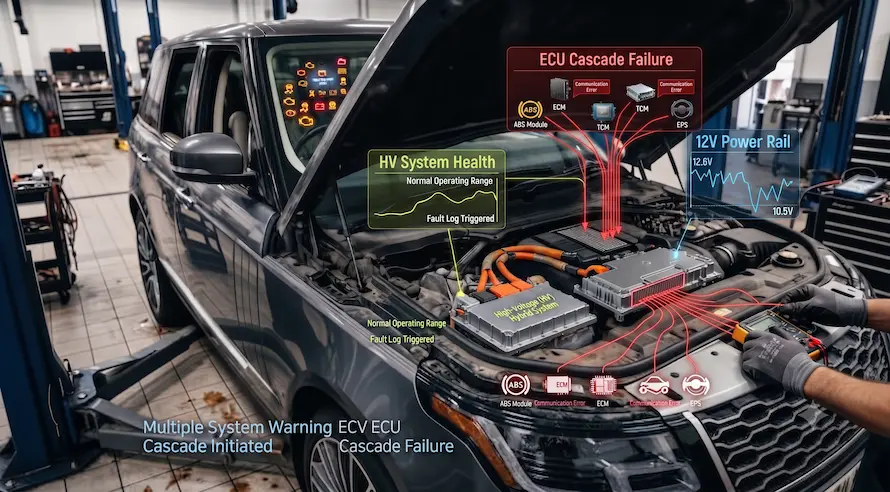
Luxury SUVs are packed with electronic systems that help control safety, comfort, engine performance, and driving functions. When the battery becomes weak, it may not provide the stable voltage these systems need.
A weak battery can trigger multiple warning lights in a luxury SUV because low voltage can affect several electronic control units at the same time.
The engine, ABS, traction control, steering, suspension, and safety systems may all detect the voltage problem and display warnings. This can make a simple battery issue look like several serious faults.
Why Can One Weak Battery Cause So Many Warning Lights?
A modern luxury SUV has many control units that communicate with each other while the vehicle is running. These units need a steady electrical supply to read sensors and carry out their functions correctly.
When battery voltage drops, communication between some systems may become unstable. The vehicle can then record fault codes or switch on warning lights as a safety measure.
This does not always mean that every system showing a warning has failed. Testing the battery and charging system first can help find the main cause.
1. Low Voltage Can Affect Multiple Control Units
Electronic control units, or ECUs, manage many parts of a luxury SUV. There may be separate units for the engine, transmission, brakes, steering, air suspension, lights, and comfort systems.
When the battery is weak, voltage can fall below the level needed by these units, especially during engine start-up. Several ECUs may then record temporary faults at the same time.
As a result, the dashboard can show several warning lights after one weak start. Once the battery and voltage supply are restored, some temporary warnings may disappear.
2. The ABS and Traction Control Systems Need Stable Power
ABS and traction control systems use sensors to monitor wheel speed and vehicle movement. Their control units need reliable voltage to process this information and communicate with other systems.
A sharp voltage drop during starting can cause the ABS or traction control system to record a fault. The driver may then see warning lights even though the brake components and wheel sensors are working normally.
A proper diagnostic check can determine whether the warning comes from a genuine component fault or from an earlier low-voltage event.
Many luxury SUVs use electric power steering or steering systems with electronic control. These systems can require a good supply of electrical power to operate correctly. If voltage drops too far, the steering control unit may detect an abnormal condition and display a warning.
In some cases, the steering may feel heavier until the problem is corrected. Drivers should never ignore a steering warning, but they should also remember that low battery voltage can sometimes be the reason behind it. Battery testing should form part of the initial inspection.
4. Air Suspension May Show a Warning
Some luxury SUVs use air suspension to change ride height and provide a smoother driving experience. This system depends on an electric compressor, valves, sensors, and control units.
When battery voltage is too low, the compressor may not operate correctly, or the control unit may store a fault. The dashboard can then show an air suspension warning.
If the suspension was working normally before a weak start, checking the battery and charging system may be useful before replacing suspension parts. A voltage problem can sometimes create a warning without permanent suspension damage.
5. Engine Management Can Record Fault Codes
The engine control unit needs stable electrical power to manage fuel delivery, ignition, sensors, emissions systems, and other engine functions. During starting, a weak battery can cause voltage to drop sharply.
This may interrupt normal communication or create temporary sensor readings that the engine computer considers unusual. A check engine light can then appear.
Drivers may assume there is an immediate engine problem, but a battery and charging test can help rule out low voltage as the cause. Diagnostic codes should always be checked before deciding which parts need repair.
6. Transmission Electronics Can Also Be Affected
Modern automatic transmissions use electronic control systems to manage gear changes. These systems communicate with the engine and other vehicle modules. When voltage is unstable, the transmission control unit may store a fault or change its operation to protect the gearbox.
A driver could notice a warning message, delayed shifting, or unusual gear changes after a weak battery event. This does not automatically mean the transmission has a major mechanical problem. Checking battery voltage, charging performance, and stored fault codes can help separate an electrical issue from a genuine transmission fault.
7. Safety Features May Temporarily Switch Off
Luxury SUVs often have advanced safety features such as lane assistance, blind spot monitoring, parking cameras, parking sensors, and automatic emergency braking. These features depend on several sensors and control units working together.
Low voltage can interrupt communication between these parts and cause some systems to become unavailable. The driver may see several messages saying that safety features are limited or unavailable.
Once the battery problem is fixed and the vehicle completes its normal system checks, some warnings may clear. Persistent warnings still require proper inspection.
8. Dashboard Warnings Can Appear After a Difficult Start
A difficult engine start is one of the most common times for low-voltage warnings to appear. The starter motor needs a large amount of current, and a weak battery may struggle to supply it. As voltage drops, different electronic systems can briefly lose the stable power they need.
After the engine starts, the alternator may restore normal voltage, but some control units may already have stored fault codes. This is why a driver may see several warning lights immediately after a slow or difficult start.
How Can You Tell If the Battery Is the Main Problem?
A weak battery is more likely to be the main cause when several warning lights appear together after slow engine cranking or a failed start. Other signs can include dim interior lights, electronic screens restarting, start-stop functions becoming unavailable, or repeated jump-starts.
If the warning lights appeared suddenly and several unrelated systems were affected at the same time, checking the battery is a sensible first step.
However, drivers should not assume that every warning is caused by the battery. Proper testing is needed to confirm the cause.
Why Professional Battery Testing Is Important
Luxury SUVs can be more difficult to diagnose because one electrical problem may affect several systems at once. A professional inspection can test the battery, alternator, starter, connections, and stored fault codes together.
This gives a clearer picture of what is actually happening instead of relying only on dashboard warnings. If the battery has reached the end of its useful life, Battery Zone UAE is a trusted choice for car battery change in Dubai, helping drivers check the battery condition and find a suitable replacement when needed.
Conclusion
A weak battery can cause multiple warning lights in a luxury SUV because so many vehicle systems depend on stable electrical power. Low voltage can affect the ABS, traction control, steering, air suspension, engine, transmission, and advanced safety features at the same time.
Seeing several warnings does not always mean that several expensive parts have failed. Battery and charging system testing should be one of the first steps when multiple warnings appear together.
If the battery is no longer reliable, choosing a trusted service for car battery replacement can help restore stable starting power and reduce the risk of repeated low-voltage problems.