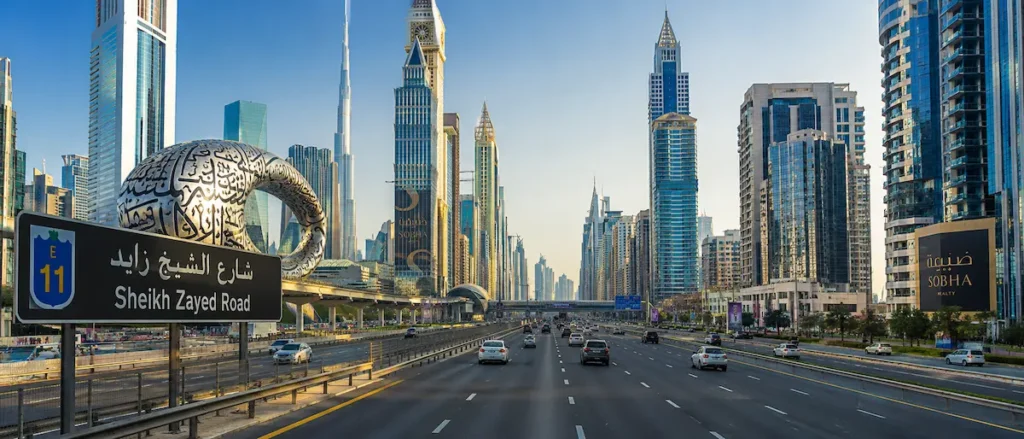
There is a road in Dubai that does not merely connect Point A to Point B. It tells a story. Every kilometre of Sheikh Zayed Road carries the weight of a nation’s ambition, the brilliance of its architects, and the daily pulse of millions of people who live, work, and dream alongside it. Drive it once at sunrise, when the glass towers blush gold and the highway stretches ahead like a ribbon of possibility, and you will understand why residents speak of it with something close to affection.
Sheikh Zayed Road — officially designated as the E11 highway — is the main arterial road of Dubai and one of the most strategically important roads in the entire UAE. It runs along the western coastal edge of the emirate, connecting Dubai with Abu Dhabi to the south and linking the northern emirates to the north. But to reduce it to a highway would be a disservice. Sheikh Zayed Road is the spine of modern Dubai, the address of its ambitions, and the living canvas on which the city keeps reinventing itself.
This guide is for anyone who wants to understand what Sheikh Zayed Road truly is: the landmarks that define it, the hotels and dining that line it, the metro that runs beside it, the traffic culture that governs it, and the future that awaits it.
The Road That Carries a Nation’s Name
Sheikh Zayed Road is named after Sheikh Zayed bin Sultan Al Nahyan, the founding father and first President of the United Arab Emirates. It is not just a street name — it is a declaration of identity. Sheikh Zayed’s vision of a unified, prosperous, forward-looking nation is mirrored in every tower that lines this road. The naming honours a leader who transformed a desert landscape into one of the world’s most talked-about cities, and the road itself has become the most visible symbol of that transformation.
Stretching approximately 55 kilometres through Dubai, the road runs from the Dubai-Abu Dhabi border in the south to the outskirts of Sharjah in the north, though the stretch that most visitors and residents refer to when they say ‘Sheikh Zayed Road’ is the central urban corridor — roughly from interchange 1 near Trade Centre Roundabout to interchange 7 near Mall of the Emirates and beyond.
What began as a relatively modest desert road in the 1970s evolved through the 1990s and into the 2000s into one of the most architecturally dense corridors in the world. Land either side of the road became the most coveted real estate in the UAE, and the towers that emerged are not just buildings — they are statements.
Sheikh Zayed Road: Quick Facts at a Glance
| Detail | Information |
| Official Name | Sheikh Zayed Road |
| Highway Code | E11 |
| Total Length | Approximately 55 kilometres through Dubai |
| Connects | Abu Dhabi (south) to Sharjah / Northern Emirates (north) |
| Metro Line | Dubai Metro Red Line (runs parallel) |
| Key Metro Stations | Emirates, Financial Centre, World Trade Centre, Al Jafiliya |
| Google Rating | 4.8 stars from 1,597+ reviews |
| Iconic Landmarks | Gevora Hotel, Emirates Towers, Museum of the Future, Dubai Frame, Clock Tower |
| Speed Limit | 100 km/h on main carriageway (camera-enforced) |
| Access | Multiple interchanges with well-signed slip roads |
Landmarks That Define Sheikh Zayed Road
To drive or ride the metro along Sheikh Zayed Road is to pass through a catalogue of architectural ambition. The landmarks here are not clustered in a theme park — they emerge organically from the roadside, each one a chapter in Dubai’s evolving story.
Gevora Hotel — The Tallest Hotel in the World
Standing at 356 metres with 75 floors, Gevora Hotel holds the Guinness World Record as the tallest hotel on the planet. Its slender, gold-toned facade is visible from much of central Dubai, and its presence on Sheikh Zayed Road is a point of immense local pride. Inside, guests find a full luxury hospitality experience that matches the drama of the building’s exterior.
Emirates Towers — Twin Icons of Commerce
The Emirates Towers — one an office block, one a hotel — were completed in the early 2000s and instantly became the defining image of modern Dubai. Clad in aluminium and reflective glass, the twin structures rise to 355 metres and 305 metres respectively. The hotel tower, Jumeirah Emirates Towers, sits just off the road and remains one of the city’s most prestigious addresses. The complex houses restaurants, a business centre, and one of the most visited retail corridors in the city.
Museum of the Future
Perhaps no building on Sheikh Zayed Road draws more cameras than the Museum of the Future. Opened in recent years to widespread global acclaim, this torus-shaped structure covered in Arabic calligraphy is described by many as the most beautiful building in the world. Its immersive exhibitions explore what human life, technology, and urban living might look like in coming decades. The museum sits on a raised podium visible from the highway and has become a defining landmark not just of the road but of Dubai as a whole.
Dubai Frame
A short distance from Sheikh Zayed Road, the Dubai Frame offers one of the most dramatic perspectives available to any visitor. The 150-metre-high picture frame bridges old Dubai (visible to the north) and new Dubai (visible to the south through its glass-floored sky bridge). It is a literal and metaphorical frame for the city’s transformation, and its proximity to the road makes it an easy stop on any Sheikh Zayed Road itinerary.
The Clock Tower (Trade Centre Roundabout)
At the northern end of the central Sheikh Zayed Road corridor stands the Trade Centre Roundabout, topped by its distinctive clock tower. This is one of the most recognisable intersections in Dubai, marking the threshold between the older city and the glass canyon of modern skyscrapers. The Dubai World Trade Centre complex nearby hosts some of the largest international exhibitions and conferences in the region.
Downtown Dubai — Within Easy Reach
Although technically positioned just off Sheikh Zayed Road, Downtown Dubai is so closely connected — via multiple access points and feeder roads — that many people consider it part of the broader Sheikh Zayed Road experience. The Burj Khalifa, the tallest structure on earth at 828 metres, is clearly visible from the highway. The Dubai Mall, Dubai Fountain, and the Opera District are all within minutes of the main road.
Key Landmarks Near Sheikh Zayed Road
| Landmark | Category | Proximity to Road |
| Gevora Hotel | World’s Tallest Hotel | Direct frontage |
| Emirates Towers | Hotel & Office Complex | Immediate vicinity |
| Museum of the Future | Cultural & Technology | On-road landmark |
| Dubai Frame | Observation & Heritage | 5 minutes away |
| Trade Centre Clock Tower | Historic Intersection | Direct frontage |
| Burj Khalifa | World’s Tallest Building | 5–7 minutes |
| Dubai Mall | Retail & Entertainment | 5–7 minutes |
| Shangri-La Hotel Dubai | Luxury Hotel | Direct frontage |
| Fairmont Dubai | Luxury Hotel | Direct frontage |
| Dubai World Trade Centre | Events & Exhibitions | Adjacent |
Hotels on Sheikh Zayed Road: Where Luxury Meets Location
No stretch of road in the UAE — perhaps in the entire Middle East — offers a higher concentration of five-star and luxury hotels than Sheikh Zayed Road. From long-established names to newer entrants, the options available to visitors are exceptional.
The H Hotel Dubai is one of the standout addresses along this corridor. Positioned directly on Sheikh Zayed Road, it combines business-class facilities with a warmth of hospitality that distinguishes it from more corporate addresses. Guests enjoy panoramic city views, access to multiple dining concepts, and a location that puts the metro, the financial district, and major landmarks all within easy reach.
The Shangri-La Hotel Dubai brings its signature Asian-influenced luxury to the road, with interiors that feel genuinely calm amidst the city’s intensity. Fairmont Dubai, with its distinctive checkerboard exterior, is another long-term fixture that continues to draw both business and leisure guests. The Address Downtown and various Marriott and Hilton properties nearby round out a hospitality offer that caters to every taste and travel purpose.
For those travelling on business, the proximity of these hotels to the Dubai International Financial Centre (DIFC) and the Dubai World Trade Centre is a significant practical advantage. Morning meetings, evening dinners, and after-work gatherings at the restaurants of Sheikh Zayed Road’s hotels have become a well-worn rhythm for the city’s professional class.
Sheikh Zayed Road and the Dubai Metro Red Line
One of the great advantages of Sheikh Zayed Road — and one that sets it apart from comparable urban corridors in the region — is the presence of the Dubai Metro Red Line running directly alongside it. The elevated metro track follows the road through its central stretch, with multiple stations serving the key zones of activity.
The Emirates Metro Station provides access to Emirates Towers and the DIFC. The Financial Centre Station places commuters at the heart of Dubai’s banking and professional services district. The World Trade Centre Station connects passengers to the exhibition complex. Al Jafiliya Station serves the southern end of the corridor. Together, these stations make Sheikh Zayed Road one of the most publicly accessible commercial corridors in the city.
The metro option is particularly valuable during rush hour, when road traffic on Sheikh Zayed Road can be heavy. Early morning and late afternoon, particularly on weekday mornings heading towards the city and evenings heading outward, sees the road at its busiest. Metro ridership on this stretch is consistently high, reflecting how effectively the rail link complements the road.
For tourists, the Red Line connection to Union Station (for the Green Line) and the link to Dubai International Airport via the metro make Sheikh Zayed Road genuinely easy to access even without a private vehicle or taxi.
Traffic and Road Culture: What You Will Notice
One of the most remarked-upon aspects of Sheikh Zayed Road — and something that appears repeatedly in visitor accounts — is the standard of driving behaviour and road discipline. Traffic flows in an orderly fashion that surprises many first-time visitors from cities where lane discipline is loose and horn-sounding is constant.
Speed cameras are positioned throughout the road, and the enforcement culture means that drivers maintain appropriate speeds and respect traffic signals. Overtaking is done through proper lane use rather than erratic manoeuvres. The road’s maintenance standards — clean surfaces, well-marked lanes, functional signage — contribute to an experience that feels genuinely world-class.
This is not accidental. The Roads and Transport Authority of Dubai (RTA) maintains Sheikh Zayed Road to an exceptional standard, and traffic management during peak hours, major events, and adverse weather is actively overseen. The result is a road that, even at capacity, functions with a degree of calm that reflects the city’s broader approach to public infrastructure.
Dining, Cafes, and the Social Life of the Road
Sheikh Zayed Road is not purely a commercial and transit corridor — it is also a place where people eat, socialise, and unwind. The base floors of its towers and the podium levels of its hotels house dozens of restaurants, cafes, and bars that collectively represent a cross-section of global cuisines.
Fine dining establishments along the corridor draw Dubai’s business community for working lunches and client dinners. International chains sit alongside independent concepts from the region’s emerging restaurant scene. The road’s proximity to DIFC — home to some of Dubai’s most celebrated restaurant addresses — adds a further culinary dimension for those exploring on foot or by short taxi ride.
Weekend evenings see families and groups of friends gathering at the casual dining and cafe concepts around the Trade Centre end of the road. The sight of people walking the wide pavements, photographing the illuminated towers, or sitting at pavement tables is a reminder that Sheikh Zayed Road, for all its scale, is a lived-in place.
Sheikh Zayed Road at Night: A City in Full Colour
The experience of Sheikh Zayed Road changes dramatically after dark. The towers that stand as glass-and-steel monoliths during the day transform into vertical canvases of light. Building illuminations, advertising displays, and the warm glow of hotel lobbies create a visual atmosphere that no photograph fully captures.
The metro elevated track, lit from below, adds a futuristic dimension to the scene. Driving south along the road on a clear night, with the towers rising on either side and the Burj Khalifa pulsing with its nightly light show visible in the near distance, is one of those genuine Dubai experiences that stays with you.
During major events — whether international summits, national celebrations, or world expos — the road takes on additional festive character. Flags, projections, and coordinated lighting displays transform it into something closer to a stage set than a highway. These moments reinforce why Sheikh Zayed Road is not just infrastructure but spectacle.
The Commercial Heartbeat: Business, Finance, and Trade
Sheikh Zayed Road is the address of corporate Dubai. The towers lining its central stretch house the regional offices of multinational corporations, international banks, law firms, consulting houses, and technology companies. The Dubai International Financial Centre (DIFC), accessible directly from the road, is a globally recognised financial hub with its own legal system, regulator, and an address that carries weight in boardrooms from London to Singapore.
The Dubai World Trade Centre, situated at the northern end of the prime stretch, hosts the large international exhibitions and trade shows that bring hundreds of thousands of business visitors to the city each year. GITEX Technology Week, Arabian Travel Market, and Cityscape are among the events that regularly fill the hotels and conference spaces of Sheikh Zayed Road.
For companies seeking an address that signals seriousness and ambition, Sheikh Zayed Road remains the default choice. Office space here commands premium rents, and the competition for prime floors in the road’s towers reflects how deeply ingrained the address has become in the city’s commercial identity.
Practical Tips for Visiting Sheikh Zayed Road
- Take the Dubai Metro Red Line for the most stress-free experience during peak traffic hours.
- The best viewpoint for the full skyline is from the road itself — either as a passenger in a vehicle or from the metro’s elevated vantage point.
- Sunrise and sunset offer the most dramatic light on the towers. Plan a drive or walk for these times if you want memorable photographs.
- Most major hotels on the road offer lobby cafes that are open to non-guests — a comfortable base for taking in the environment.
- Parking is available at the World Trade Centre and in the basement facilities of major hotels, though metro access remains the most practical for leisure visitors.
- Walking the full length of the central Sheikh Zayed Road stretch is practical in cooler months (November to March). Summer heat makes long outdoor walks inadvisable.
- Dubai taxi services and ride-hailing apps work well throughout the corridor. Journey times vary significantly depending on time of day.
Why Sheikh Zayed Road Rates 4.8 Stars from Over 1,597 Reviews
The Google rating of 4.8 from more than 1,597 reviews is not something that happens to a road by accident. It reflects an accumulation of individual experiences — commuters who found it reliable, tourists who found it spectacular, residents who found it central to their daily lives, and visitors who simply stood at the edge of it and marvelled.
The reviews speak to cleanliness, scale, futuristic atmosphere, landmark density, and a sense of order that feels both impressive and reassuring. People compare it favourably to iconic roads in other global cities. Many say it exceeded expectations. Several note that no number of photographs prepares you for the experience of actually being there.
For a stretch of highway to earn this kind of response — consistently, from people of dozens of nationalities visiting for dozens of different reasons — suggests that Sheikh Zayed Road is doing something genuinely right. It is infrastructure that aspires to be architecture, and a city artery that aspires to be an experience.
The Future of Sheikh Zayed Road
Dubai does not stand still, and neither does Sheikh Zayed Road. Ongoing construction projects continue to reshape its skyline. New tower approvals, hotel expansions, and urban realm improvements suggest that the road has not yet reached its final form. Smart city infrastructure is being progressively integrated — traffic management systems, pedestrian enhancements, and public space improvements are all part of the vision for the next phase of the road’s evolution.
Transport diversification is also on the horizon. Discussions around expanded metro capacity, improved pedestrian connectivity between the road and adjacent neighbourhoods like DIFC and Downtown, and the long-term development of cycling and active transport routes reflect a city thinking carefully about how its flagship corridor can serve an even wider range of users.
What seems certain is that Sheikh Zayed Road will remain the primary reference point for Dubai’s identity as a global city. Every major development that the city undertakes is, in some way, measured against the standard that this road has set.
Conclusion: More Than a Road
Sheikh Zayed Road is, at its most functional, a highway. It moves people and goods and commerce through the heart of one of the world’s most dynamic cities. But function alone does not explain the 4.8-star rating, the photographs shared by millions, or the quiet pride with which residents speak of it.
It is the embodiment of a vision — the vision of a nation that decided, decades ago, to build something the world had not seen before. Every tower on Sheikh Zayed Road is a sentence in that story. The road itself is the thread that holds the narrative together.
Whether you are visiting Dubai for the first time or the fortieth, whether you are a resident heading to work or a tourist trying to understand what makes this city extraordinary, Sheikh Zayed Road offers an answer. Take it in at speed from a taxi. Take it in slowly from the metro. Or stand still at the edge of it for a moment and let the scale of what human ambition looks like, when properly resourced and genuinely committed, settle over you.
Few roads in the world have earned the right to be called iconic. Sheikh Zayed Road is one of them.
Frequently Asked Questions About Sheikh Zayed Road
| Question | Answer |
| What is Sheikh Zayed Road also known as? | Sheikh Zayed Road is the common name for the E11 highway, the main arterial road running through Dubai and connecting it to Abu Dhabi and the northern emirates. |
| How long is Sheikh Zayed Road in Dubai? | The road runs for approximately 55 kilometres through the emirate. The urban core stretch with the major skyscrapers covers roughly 10 to 12 kilometres. |
| Which metro stations are on Sheikh Zayed Road? | Key Red Line stations include Emirates, Financial Centre, World Trade Centre, and Al Jafiliya. The metro runs elevated alongside the road through this stretch. |
| What is the tallest hotel on Sheikh Zayed Road? | Gevora Hotel holds the Guinness World Record as the tallest hotel in the world, standing at 356 metres with 75 floors, and is located directly on Sheikh Zayed Road. |
| Is Sheikh Zayed Road safe to drive? | Yes. The road is well-maintained with speed cameras, clear lane markings, and strong enforcement of traffic rules. Visitor reviews consistently praise the orderly driving culture. |
| What is the best time to visit Sheikh Zayed Road? | Sunset and after dark offer the most dramatic visual experience. Cooler months (November to March) are ideal for those who want to walk sections of the road. |
| Can tourists walk along Sheikh Zayed Road? | There are pavements along sections of the road, and walking is comfortable in cooler weather. The best pedestrian experience is around the Trade Centre and Emirates Towers area. |
| Is the Museum of the Future on Sheikh Zayed Road? | Yes. The Museum of the Future is situated directly on Sheikh Zayed Road and is one of the most visually distinctive landmarks visible from the highway. |
| What hotels are located directly on Sheikh Zayed Road? | Several five-star hotels have direct frontage, including The H Hotel Dubai, Shangri-La Hotel Dubai, Fairmont Dubai, and Gevora Hotel, among others. |
| How close is Burj Khalifa to Sheikh Zayed Road? | The Burj Khalifa is located in Downtown Dubai, which is accessed via feeder roads directly off Sheikh Zayed Road. It is typically a 5 to 7 minute drive from the main road. |