
Anyone who has sat down to fill out an online order, a bank application, or a courier form in the UAE capital has hit the same wall: a field marked “Postal Code” or “ZIP Code” that simply does not have an answer. You scroll through your memory, check your Emirates ID, glance around your apartment for a bill with a code printed on it, and come up empty. That confusion is not a personal failure or a sign you have missed something obvious. It is a structural fact about how mail and addressing work in Abu Dhabi, and understanding it properly will save you time on every form you fill out from now on.
This guide walks through the real situation on the ground: why Abu Dhabi never adopted a postal code system in the first place, what you should type into that stubborn form field, how PO Boxes actually function as the backbone of mail delivery, and what the newer Onwani addressing initiative changes (and does not change) about all of this. Everything here reflects how things currently work for residents, businesses, and visitors dealing with UAE addresses.
The Short Answer
No. Abu Dhabi does not have an official postal code or ZIP code, and neither does any other emirate in the UAE. When a form absolutely insists on a value in that field, the accepted convention across banks, government portals, courier companies, and online stores is to enter 00000, write N/A, or leave the field blank if the system allows it. There is no hidden five-digit number specific to your building or neighbourhood waiting to be discovered. It genuinely does not exist.
Why the UAE Never Adopted a Postal Code System
Postal codes exist in countries like the United States, the United Kingdom, and India because those nations built house-to-house mail delivery networks that needed a way to sort enormous volumes of post down to a specific street or block. The UAE’s postal history took a different path. Organised postal services in the region trace back to 1909, when mail in what is now the UAE was handled through the Indian Postal Service. That arrangement continued until India’s independence in 1947, and the country’s own postal directorate was only formally established under the Ministry of Communications in 1972, shortly after the federation itself was founded.
By the time the UAE was building its modern infrastructure through the 1970s and 1980s, the population was small, growth was concentrated in a handful of urban centres, and a centralised box-collection model made far more practical sense than mapping every street into postal zones. Instead of delivering letters to individual doors, Emirates Post built its system around rented boxes at post office branches, a model that persists today and explains why the postal code field on so many international forms simply has nothing to plug into it.
What to Actually Type When a Form Demands a Postal Code
In practice, three approaches are all treated as valid across the UAE:
- Enter 00000 — the most widely accepted placeholder, recognised by banks, government portals like ICP and TAMM, and most e-commerce checkouts.
- Write N/A — works on forms designed with some flexibility, especially paper applications and manually reviewed submissions.
- Leave the field blank — only safe on forms that do not enforce the field as mandatory.
If a website rejects 00000 outright because its validation logic expects a real postal code format from a different country, try N/A first, and if that also fails, a support ticket to the merchant is usually the fastest fix rather than guessing at random digit combinations.
The PO Box System: How Mail Delivery Actually Works
Since there is no street-level delivery network, the real address that matters in Abu Dhabi is a PO Box number. Every serious piece of mail, from bank statements to government correspondence to online purchases that ship via post rather than courier, ultimately needs a PO Box to land in. Individuals and companies rent these boxes directly from Emirates Post at a branch near them, sign an annual contract, and collect a physical key or access code. Rental costs vary by box size and location but typically sit in the AED 300 to AED 500 per year range for a standard personal box, and boxes must be renewed annually to stay active.
A typical Abu Dhabi mailing address, once you strip out the postal code confusion, looks like this:
| Address Line | Example |
| Recipient Name | Fatima Al Mazrouei |
| PO Box | P.O. Box 4526 |
| City / Emirate | Abu Dhabi, United Arab Emirates |
| Postal Code Field (if required) | 00000 |
Onwani: Abu Dhabi’s New Digital Address System
The most meaningful development in this space is Onwani, an Arabic word meaning “my address.” Rolled out by Abu Dhabi’s Department of Municipalities and Transport, Onwani assigns every building in the emirate a structured, unique reference made up of a building number, a street name, and a locational code, alongside a scannable QR sign fixed to the building itself. The intent is not to recreate a Western-style postal code system, but to give emergency responders, logistics companies, and delivery drivers a precise, GPS-linked way to find a specific building rather than relying on landmarks and phone calls, which has historically been the norm.
The scale of the rollout gives a sense of how thorough the system is meant to be. It is built to cover roughly 240 districts, around 1,900 mapped streets, close to 4,900 new traffic and street signboards, and address details for approximately 180,000 buildings across the emirate.
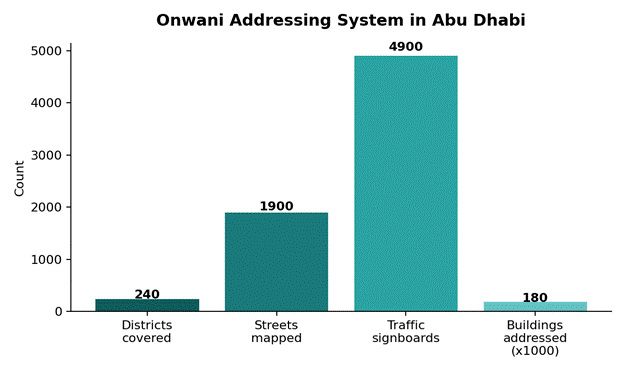
Figure 1: Scale of the Onwani addressing rollout across Abu Dhabi, by the numbers.
It is worth being clear about what Onwani is not: it is not a five-digit ZIP code you can enter on an international shipping form, and adoption on courier and e-commerce platforms is still uneven. For now, it works alongside the PO Box system rather than replacing it, and most day-to-day mail still ends up in a rented box regardless of whether a building also carries an Onwani reference.
Onwani vs. Makani: Two Different Systems, Often Confused
A common point of confusion is mixing up Abu Dhabi’s Onwani with Dubai’s Makani, since both aim to solve the same underlying problem of precise location identification in a country without street-based postal codes. They are not the same system and are not interchangeable.
| Feature | Onwani (Abu Dhabi) | Makani (Dubai) |
| Format | Building number + street name + QR code | 10-digit numeric code |
| Introduced by | Department of Municipalities and Transport, Abu Dhabi | Dubai Municipality |
| Primary use | Addressing, mail, emergency response | Precise GPS location for any point in the city |
| Physical marker | QR-coded building signage | No physical sign; number is looked up digitally |
Common Mistakes People Make With Abu Dhabi Addresses
- Typing in a random five-digit number because a form refuses to submit without one, rather than trying 00000 or N/A first.
- Assuming Dubai’s Makani number will work as a substitute for a postal code in Abu Dhabi, or vice versa.
- Letting a PO Box rental lapse and missing bank statements, visa correspondence, or parcels as a result.
- Confusing a company’s trade licence number or Emirates ID number with a postal code when a form is ambiguously labelled.
- Assuming every courier needs a PO Box — in reality, most private courier companies (as opposed to Emirates Post) deliver using a phone number, a Makani/Onwani-style reference, or simple directions rather than a box number.
Is Abu Dhabi Unusual in This Regard?
Not particularly. A number of countries across the Middle East operate without a formal postal code system, relying instead on PO Boxes, landmark-based directions, or emerging digital addressing tools, so the situation in Abu Dhabi sits within a broader regional pattern rather than being an isolated case.
For background on how Emirates Post itself developed into the country’s official postal operator, the Wikipedia entry on Emirates Post traces the organisation from its 1909 origins through to today.
It is also worth reading real resident experiences on the topic, such as this Quora thread on Abu Dhabi’s postal code question, where long-time UAE residents explain the PO Box system in their own words.
If You Are New to Abu Dhabi: A Quick Setup Checklist
- Confirm whether your employer or building management already provides a shared PO Box before renting your own.
- Visit or call the nearest Emirates Post branch to rent a personal or company PO Box if you need one.
- Use 00000 as your default entry on any online form that will not accept a blank postal code field.
- Check whether your building has been added to the Onwani system, and note the QR code on the entrance if it has.
- Keep your PO Box renewal date somewhere visible — lapses are one of the most common reasons mail goes missing.
If you are also handling shipments or customs paperwork, it helps to see how the same postal code confusion plays out for importers in our guide to the Dubai Trade container enquiry process.
The Bottom Line
Abu Dhabi does not have a postal code, and that is not a gap in the system so much as a different design choice that has worked for the UAE for decades. For everyday form-filling, 00000 or N/A gets the job done. For anything that genuinely needs to reach you by mail, a rented PO Box from Emirates Post remains the dependable option, while Onwani is quietly building a more precise, GPS-linked layer on top of that for the buildings it already covers. Once you understand these three pieces working together, the postal code field on any UAE form stops being a source of confusion and becomes a two-second formality.
Frequently Asked Questions
Does Abu Dhabi have a ZIP code or postal code?
No. Abu Dhabi, along with every other emirate in the UAE, does not operate a formal postal or ZIP code system. When a form requires an entry, residents commonly use 00000 or N/A.
What should I write in the postal code field when ordering something online in Abu Dhabi?
Use 00000 first. If the checkout system rejects it, try N/A, and if that fails too, contact the retailer’s support team, since the issue is usually with the form’s validation rules rather than a missing code on your end.
How do I actually receive mail in Abu Dhabi without a postal code?
Through a PO Box rented from Emirates Post. This box number, combined with your name and “Abu Dhabi, United Arab Emirates,” functions as your working postal address for anything sent through the postal network.
Is Onwani the same thing as a postal code?
Not exactly. Onwani is a structured addressing system that assigns a building number, street name, and QR-coded signage to properties across Abu Dhabi. It is designed to improve navigation, logistics, and emergency response rather than to function as a five-digit postal code in the traditional sense.
What is the difference between Onwani and Makani?
Onwani is Abu Dhabi’s addressing initiative built around building numbers and street names. Makani is Dubai’s separate 10-digit geolocation system. The two are run by different authorities and are not interchangeable between emirates.
How much does a PO Box cost in Abu Dhabi?
Pricing varies by box size and branch, but a standard personal PO Box typically costs somewhere between AED 300 and AED 500 per year through Emirates Post, renewable annually.
Can couriers deliver to my home address without a PO Box or postal code?
Yes, in many cases. Private courier and delivery companies (distinct from Emirates Post) generally rely on your phone number, building name, and directions, or an Onwani/Makani-style reference, rather than requiring a postal code or PO Box.
Will Abu Dhabi ever introduce a full postal code system?
There is no confirmed nationwide plan to introduce a traditional postal code system. The current direction of investment is toward digital addressing tools like Onwani and Makani rather than a conventional ZIP code grid.
Related Reading
If you are settling into the capital, our visitor guide to Khalifa Park Abu Dhabi is a good next stop for weekend planning.
Anyone who enjoys the outdoors should also see our roundup of the best fishing spots in Abu Dhabi, including licensing rules and gear recommendations.
For food lovers, our guide to the best Kerala restaurants in Abu Dhabi covers the capital’s most trusted South Indian kitchens.
If your address questions are tied to shipping or imports, our explainer on the Dubai Trade container enquiry process covers how tracking and documentation work across the UAE, including the same postal code field confusion at customs stage.
Disclaimer
This article is written for general informational purposes for UAE residents and visitors. Postal, courier, and government procedures can change over time, and readers should confirm current requirements directly with Emirates Post, their bank, or the relevant government portal (such as TAMM) before relying on any detail here for an official submission. This content is not affiliated with or endorsed by Emirates Post, the Department of Municipalities and Transport, or any government entity mentioned.