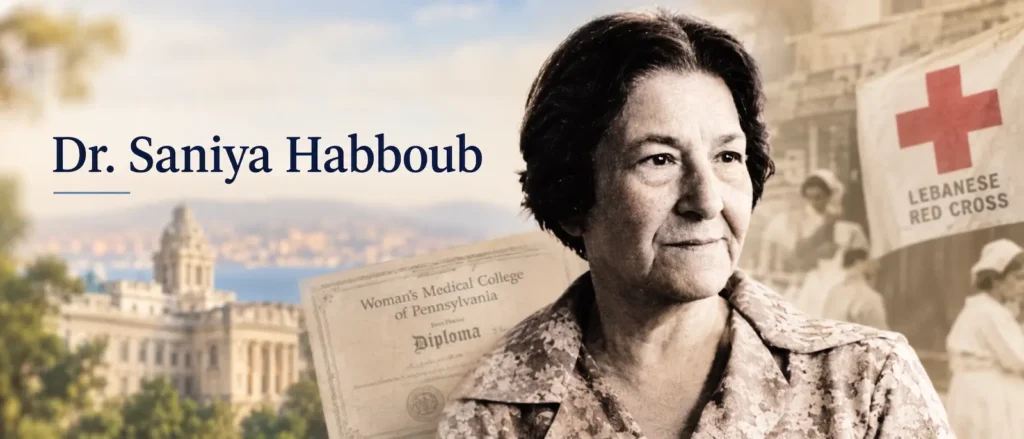
| At a glance Who she was: a Lebanese physician born in Beirut and trained in gynecology and obstetrics. Why she matters: she was the first Lebanese woman to study medicine abroad, and the only Arab graduate of her class at the Woman’s Medical College of Pennsylvania. What she did: she opened a clinic in Beirut that offered free care to women who could not pay, and she served on the boards of several charities. Honours: Lebanon’s Health Medal of Merit, a street named after her in Beirut, and a Google Doodle. UAE connection: none. She lived and worked in Lebanon. Pages that place her in a Dubai or Abu Dhabi clinic are wrong. |
Type the name Dr. Saniya Habboub into a search bar in Dubai, Sharjah or Abu Dhabi and the results can feel strange. One page talks about her as if she were a modern doctor with opening hours. Another tells you she studied “in the best schools of the Middle East.” Neither is right. Dr. Saniya Habboub was a Lebanese woman of the early twentieth century, and the real story is more interesting than the vague versions that float around the web.
This guide sticks to what the records support. You will read where she was born, why she crossed the Atlantic to become a doctor, what she did when she came home, and how the world remembered her. Where the sources disagree, we say so plainly instead of smoothing it over. We also explain why her name keeps showing up in UAE search results, and how you can avoid being misled by thin biography pages.
Quick facts about Dr. Saniya Habboub
| Detail | What the sources say |
| Full name | Saniya Moustafa Habboub (also spelled Saniyeh, Sania or Saniyya); Arabic: سنية حبوب |
| Born | 1901, Beirut, Lebanon. The exact day and month are not documented in the sources we checked. |
| Died | September 1983, aged 82 |
| Religion | Muslim family background, according to Wikipedia |
| Parents | Moustafa Habboub, a leather merchant, and Adla al-Jazairy |
| Husband and children | Married Muhammad al-Naqqash, a journalist; they had two daughters |
| Specialty | Gynecology and obstetrics |
| Medical degree | 1931, Woman’s Medical College of Pennsylvania, Philadelphia |
| Clinic | Bab Idriss neighbourhood, Beirut |
| Main honour | Health Medal of Merit from the Lebanese government, 1982 |
Early life in Beirut
Saniya Habboub was born in Beirut in 1901. Her father, Moustafa, traded in leather. Her mother, Adla al-Jazairy, could not read or write, yet she admired educated women and made her daughter’s schooling a priority. That detail matters. In that period, plenty of Beirut families saw little point in sending girls far beyond the basics. Saniya’s mother saw it differently, and the choice shaped everything that followed.
Saniya went on to the American Junior College for Women, the institution that later grew into the Lebanese American University. Google’s biography says she was one of the first three students to graduate from it in 1926, while an article in the university’s own journal, Al-Raida, places that graduation a year earlier. We mention both because careful readers will notice the gap, and because it is a good reminder that old records rarely agree to the last digit.
Why Dr. Saniya Habboub left Lebanon to study medicine
After the junior college she enrolled at the American University of Beirut. The plan was medicine, but there was a wall in the way: the university’s medical programme did not admit women at that time. According to the Al-Raida profile, the social setting around mixed classes and dress also weighed on her decision. Google adds a lovely detail. She had heard about a doctor from Damascus who trained in the United States and then came home to open a clinic, and that story set her sights.
So she went to America. In the late 1920s a young Muslim woman from Beirut travelling alone across the ocean to study medicine was close to unheard of. An American newspaper of the time even remarked on her bobbed hair, which tells you how much attention she drew. She did not seem to mind. She had a degree to earn.
Philadelphia and the medical degree
Her destination was the Woman’s Medical College of Pennsylvania, a school created so that women could train as physicians when most medical schools shut them out. She graduated in 1931 and was the only Arab graduate of the school. She then stayed on into 1932 for an internship in gynecology and obstetrics.
Graduation day carried a small moment of honour. The college invited the Lebanese historian Philip Hitti, a professor at Princeton, to give the commencement address, a gesture meant to recognise a distinguished compatriot in the room. Dr. Habboub answered the kindness in her own way. She set up a scholarship in her name at the college so that future students could follow her. Google chose June 10 for its Doodle because that date marks her graduation.

Figure 1. Milestones in Dr. Saniya Habboub’s life. Dates follow Wikipedia, Google and Al-Raida.
Coming home: the Bab Idriss clinic
Dr. Habboub returned to Lebanon in 1932, according to Wikipedia and Al-Raida. Google dates her return and the start of her practice to 1933. Either way, she opened a small clinic in Bab Idriss, the Beirut neighbourhood where she lived. Wikipedia records that the clinic offered free services to women who could not afford her fee, and that she was the first woman physician trained abroad to open a practice in the city.
Think about what that meant on an ordinary weekday. A woman in a crowded part of Beirut could now walk to a clinic, speak with a female doctor about pregnancy, childbirth or illness, and not be turned away because her purse was thin. For many families, that was the first time such care sat within reach.
Public service beyond the clinic
Her work did not stop at the examination room. Google’s biography credits her as a co-founder of the Lebanese Red Cross association, and says she sat on the boards of the Muslim Orphans’ Home, the Young Women’s Muslim Association and Maqassed Hospital. Naming these roles in one breath makes the point clearly. She treated medicine as a public duty, not only a private career.
She also raised a family. She married the journalist Muhammad al-Naqqash and they had two daughters. For readers who search for her husband or children, that is the extent of what the main sources confirm. We have not added invented detail to fill the silence.
Honours and remembrance
In 1982 the Muslim Cultural Club in Beirut held a celebration marking fifty years of her medical work, and the Lebanese government awarded her a Health Medal of Merit the same year. She died in September 1983. A street in the Ramlet al-Baida district of Beirut carries her name. Nearly four decades later, on June 10, 2022, Google placed her story on its home page for a day, and a new generation of readers asked who she was.

Figure 2. Approximate age at each milestone, based on a 1901 birth year. Ages are rounded because her exact birthday is not documented.
The chart shows something worth pausing on. She was about thirty when she earned her medical degree, and she then practised for roughly half a century. Pioneers are often described through one big moment. In her case the long, steady stretch of ordinary work afterwards is the larger achievement.
Where the sources disagree
A trustworthy biography shows its uncertainty. These are the points on which the sources we checked do not fully line up.
| Question | One account | Another account |
| Junior college graduation | 1926 (Google Doodle biography) | 1925, one of the first three graduates (Al-Raida) |
| Return to Beirut | 1932 (Wikipedia and Al-Raida) | 1933, start of practice (Google) |
| Medical school details | Woman’s Medical College of Pennsylvania, 1931 (Wikipedia, Google) | Al-Raida also mentions earlier study at Western College in Cincinnati before Philadelphia |
| Red Cross wording | Lebanese Red Cross (Wikipedia, Google) | Some news reports write Lebanese Red Crescent |
| Exact birthday | Not documented | June 10 is sometimes repeated online, but that is her graduation date, not her birthday |
Why her name appears in UAE searches
There is no evidence that Dr. Habboub ever worked in the UAE. The country did not exist in its present form during her career, and every record places her practice in Beirut. Her name reaches UAE readers for a simpler reason. Regional media and Google’s worldwide Doodle brought her story to the Gulf, and many people here have family ties to Lebanon or simply care about the history of Arab women in medicine.
The confusion starts when clinic websites reuse a famous name or when low-effort biography pages invent a modern profile. If you want to see a doctor in the UAE, do not rely on a page that mentions Dr. Saniya Habboub. Check the physician’s licence on the official register of the relevant regulator: the Dubai Health Authority in Dubai, the Department of Health in Abu Dhabi, or the Ministry of Health and Prevention in the other emirates.
If this history makes you curious about Lebanese culture in the Emirates, a good next stop is a plate of something warm. Our friends at Arab Market Trends put together a guide to shawarma places across Dubai, Abu Dhabi and Sharjah, and Lebanese-style spots feature in the conversation.
Lessons readers take from her life
- Education can start with one stubborn parent. Her mother could not read, and still insisted on school.
- Closed doors are sometimes an invitation to look elsewhere. When one university would not teach her, she found another that would.
- Gratitude can be practical. Her scholarship in Philadelphia helped women she would never meet.
- Service outlasts titles. The free clinic and the charity boards are remembered as much as the degree.
Address and places linked to her story
Dr. Habboub has no public clinic today, so there is no office to visit. These are the real places tied to her life and memory.
| Place | Why it matters |
| Bab Idriss, Beirut, Lebanon | The neighbourhood where she opened her practice and lived |
| Sania Habboub Street, Ramlet al-Baida, Beirut, Lebanon | Street named in her memory |
| Woman’s Medical College of Pennsylvania, Philadelphia, USA | Where she earned her medical degree; the college is now part of the history of Philadelphia medicine |
| Lebanese American University, Beirut, Lebanon | Home of the Al-Raida journal that published a profile of her career |
Addresses matter when you are following a trail like this, and they are written differently across the region. If you are curious about how structured addresses work in the Gulf, Arab Market Trends explains the Saudi system in its Riyadh postal code guide. For everyday UAE online shopping, its Amazon.ae guide covers delivery and returns.
Final thoughts
The strongest way to honour Dr. Saniya Habboub is to tell her story accurately. She was not a modern clinic doctor and she was not a UAE figure. She was a determined young woman from Beirut who went where she could learn, brought her training home, treated women who had few other options and helped build charities that outlived her. If you share her biography, link to the primary sources and mention the places where records differ. That small effort keeps her memory honest.
Frequently asked questions
Who was Dr. Saniya Habboub?
She was a Lebanese physician born in Beirut in 1901. She became the first Lebanese woman to study medicine abroad and later practised gynecology and obstetrics in Beirut. You can read her profile on Wikipedia.
Is Dr. Saniya Habboub a doctor in the UAE?
No. She died in 1983 and worked only in Lebanon. Any page that lists her as a Dubai or Abu Dhabi doctor is mistaken.
How old was Dr. Saniya Habboub?
She was born in 1901 and died in September 1983, aged 82, according to Al-Raida and Wikipedia.
What was her religion?
Wikipedia states that she was born to a Muslim family. She also worked with the Muslim Orphans’ Home and the Young Women’s Muslim Association.
Who was her husband?
She married Muhammad al-Naqqash, a journalist, and they had two daughters, per the sources cited on Wikipedia.
Where did she study medicine?
She completed her degree at the Woman’s Medical College of Pennsylvania in 1931 after the American University of Beirut did not admit women to its medical programme.
Why did Google make a Doodle for her?
Google marked the anniversary of her graduation on June 10, 2022. Read the original note on the Google Doodles page.
Was she the first Arab woman doctor?
No source we checked claims that. The accurate claim is that she was the first Lebanese woman to study medicine abroad and the only Arab graduate at her college.
Does she have an Instagram or social media account?
No. She died decades before social media existed. Accounts using her name are tributes or unrelated pages.
Where can I read primary material about her?
The Al-Raida article from the Lebanese American University is a good starting point, along with the references listed at the bottom of her Wikipedia page.
Related posts
- Best Shawarma Places Near Me in the UAE
- Amazon.ae UAE Guide: Shopping, Prime and Returns Explained
- Riyadh Postal Code: Your Complete Guide to الرمز البريدي الرياض
Sources used: Wikipedia, Google Doodles, Al-Raida, Lebanese American University.
Disclaimer
This article is for general information and education. It is a historical biography and not medical, legal or professional advice. Details come from public sources such as Wikipedia, Google Doodles and the Al-Raida journal, and sources sometimes differ on dates. We link to the originals so readers can check them. Dr. Saniya Habboub passed away in 1983 and has no connection to any clinic, product or service advertised online. Always confirm a doctor’s licence with the official UAE health regulator before booking an appointment. Third-party links are provided for reference, and we are not responsible for the content of external websites.