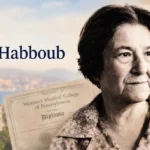

Search for Dr. Saniya Habboub and you will find a calm, smiling portrait and a short line saying she was among the first women from Lebanon to study medicine abroad. The line is true, but it hides the interesting part. This was a woman who was spat at in the street for attending university, who checked into a Damascus hotel alone and pushed furniture against the door, and who still came home to open a clinic that served an entire neighbourhood. Readers in the UAE, many of whom have Lebanese colleagues, neighbours and friends, will recognise the spirit of her story straight away.
This guide pulls together what reliable sources actually say about her, including the Wikipedia entry on Saniya Habboub, the Lebanese American University’s own feature on its alumna, and Google’s 2022 Doodle tribute. Where those sources disagree on small details, we say so instead of guessing.
Dr. Saniya Habboub at a Glance
| Detail | What the sources say |
| Full name | Saniya Moustafa Habboub (also spelled Saniyeh, Sania or Saniyya) |
| Born | 1901, Beirut, Lebanon |
| Family | Father Moustafa Habboub, a leather merchant; mother Adila al-Jazairy, who came from Turkey |
| Early schooling | American School for Girls, Beirut |
| College | American Junior College for Women (later part of the Lebanese American University); then American University of Beirut |
| Medical training | United States, with a medical degree in 1931 and further obstetrics training |
| Speciality | Obstetrics and general medicine |
| Practice | Her own clinic in Beirut, offering free care to women who could not pay |
| Honour | Health Medal of Merit from the Lebanese government, 1982 |
| Died | September 1983, aged 82 |
Early Life in Beirut
Saniya was born in 1901, the second of five children. Her father started working in a tannery in secret while still a schoolboy, because he had lost his own father young. He later bought the business and grew it into a leather workshop that made soles for Ottoman soldiers. The family settled in a villa in Ain Mreisse, and he liked to host scholars at home. According to her granddaughters, the household was probably the first on the street to own a big dining table and eat with forks.
Her mother, Adila, could not read. The family story, as told to Lebanese American University, is that she once watched a woman reading a newspaper on a train to Beirut and decided that any daughter of hers would learn to read. Both parents kept that promise, and they kept it even when the neighbours made it hard.
Childhood was not gentle. At fourteen she caught typhoid fever and lay semi-conscious for a month. Her younger sister Afifeh, who had caught it too, did not survive. The illness also left Saniya with phlebitis in her left leg, and she dragged that foot for the rest of her life. The sources we found do not say whether this shaped her choice of career, but it is hard to ignore.
Education: From Beirut Classrooms to America
She joined the very first freshman class of the American Junior College for Women in 1924. Two years later she was one of three students who graduated from the college, the first group in its history. She then moved on to the American University of Beirut, fully intending to study medicine there. Her parents agreed. Her community did not.
A woman doctor was unthinkable at the time, and a respected merchant’s daughter sitting in classes with men was close to scandalous. She later told a reporter that people spat at her in the street and cursed her parents for raising her badly. Her parents kept paying the fees anyway.
With the door at home closed, she looked abroad. She heard about a Damascus doctor who had trained in the United States, took a taxi to the city without telling anyone, and booked a hotel room by herself. He was out when she called, so she had to wait. She later recalled the clerk’s look at the desk, and said she pushed every movable piece of furniture against the door and sat up all night. That trip eventually pointed her to the Woman’s Medical College in Philadelphia.
On 11 August 1926 she was due to board a ship for New York. Her nerve failed that morning. Her mother walked into the room and told her that if she wanted to go, she should simply go. She went. The crossing took nineteen days.

Eight decades in one line: from a Beirut childhood to a national honour.
Which American college, exactly?
Here the sources split. Several articles covering the Google tribute say she graduated in 1931 from the Woman’s Medical College of Pennsylvania. The Lebanese American University feature says her medical degree came from Western College in Cincinnati, followed by two years of obstetrics training in Philadelphia. Wikipedia describes further internship training that carried her into 1932. All of them agree on 1931 as the graduation year and on Philadelphia as an important stop. If you are writing a school project, cite the source you used.
Money is a small detail that says a lot about her. Her father handed her a letter of credit before she left, and she never used it. She earned her own way by teaching embroidery and stitching. In 1928 an Ohio newspaper printed her photo under the headline “Breaks Traditions”, amazed that a Muslim woman from Beirut wore a bobbed haircut.
Career: A Clinic Where Women Could Walk In
Wikipedia and the Al-Raida journal give her return as 1932, while the university feature says 1933. Either way, she came back and opened a practice in Bab Idriss. Custom said a woman doctor should work alongside a male colleague. She refused and set up alone, offering obstetrics and general medicine.
She told an interviewer that many patients took her for a midwife at first, but they came anyway. Women from across the Basta district queued at her door and she worked around the clock. If you have ever walked through a crowded old neighbourhood such as Karama in Dubai, where a single fish market can anchor a whole community, you can picture how a trusted local clinic becomes part of daily life.
For roughly fifty years she treated poorer women without charge and made home visits. She belonged to the group that founded the Lebanese Red Cross, and she sat on the boards of the Muslim Orphan’s Home, the Young Women’s Muslim Association and Maqassed Hospital. She also served as school doctor at the American School for Girls, where her own schooling had begun.
In 1937 she married Muhammad al-Naqqash, a journalist who first arrived to interview her. He was twelve years younger, which made the match unconventional in its own right. They had two daughters, Saniya Ellen and Iffat Elizabeth. She did not push either of them toward a profession, and believed they should choose for themselves.

Her biggest steps happened in her twenties and thirties; the recognition came in her eighties.
Honours and Recognition
The Muslim Cultural Club in Beirut marked fifty years of her medical work on 19 May 1982, an event covered by Al-Raida, the Arab Institute for Women’s journal. The Lebanese government gave her the Health Medal of Merit the same year. A street in Beirut’s Ramlet al-Baida district carries her name. In June 2022 Google dedicated a Doodle to her, timed to the day she finished medical school. The National, published in Abu Dhabi, reported on the tribute for readers across the Gulf.
She also left a scholarship in her own name at the American college that trained her, funded by fees from lectures she gave across the United States. Her name is engraved on a marble pillar at the institution beside other donors.
Her Later Years and Final Words to Students
She retired in 1965. When civil war reached Beirut in 1975, her clinic was looted. She refused to rescue anything from the wreckage, and only her stethoscope and a single diploma survived. Her granddaughter says she was practical rather than sentimental, a woman who described money as a servant, never a master.
That line sits well with how many people in the UAE think about work and independence. If you are setting up your own finances after a move, our guide to a no minimum balance account in the UAE is a sensible place to start, and the same site compares the best banks in Dubai for expats. She would likely have approved of anyone choosing to stand on their own feet.
She died in September 1983 at the age of 82. Her family says she diagnosed her own pancreatic cancer. A tribute in Al-Raida carried a piece she had written in 1948 for young women at university. In it she tells them they are no longer a subject of surprise, mockery or shame. That sentence explains her life better than any summary can.
Why Her Story Matters to Readers in the UAE
Lebanese families have been part of life in the Emirates for a long time. You see it in hospital corridors, school staff rooms, offices, and on dinner tables. A Lebanese grandmother’s recipe, a family doctor from Beirut, a neighbour who still follows news from home: these are ordinary parts of living in Dubai, Sharjah or Abu Dhabi.
It is also worth remembering how many of the women who study medicine today, in the Gulf as much as anywhere, walk a path someone cleared first. Habboub is one of those people. Next time you sit down at a Lebanese restaurant, perhaps one from our list of shawarma places across the UAE, spare a thought for the country and the women’s history behind the menu.
Three lessons from her life
- Support at home matters most. Her parents took the social cost so she could study.
- Do the work where it is needed. She chose a neighbourhood of women who had few options and stayed fifty years.
- Recognition can come late. Her national honour arrived when she was 81, and a global tribute decades after her death.
Frequently Asked Questions About Dr. Saniya Habboub
Who was Dr. Saniya Habboub?
She was a Lebanese physician born in Beirut in 1901 and widely described as the first Lebanese woman to earn a medical degree abroad. See her Wikipedia profile for a short summary.
Why did Google honour her with a Doodle?
Google marked the day in 1931 when she graduated from medical school. Read the official note on the Google Doodles page.
Where did she study?
She attended the American School for Girls, the American Junior College for Women and the American University of Beirut, then trained in the United States. Details are in the LAU feature.
Was she Lebanon’s first woman doctor?
She is usually called the first Lebanese woman doctor to study medicine abroad and open a practice in Beirut afterwards. Some outlets, including The National, use looser wording, so “first to study abroad” is the safer claim.
What did she do after returning home?
She opened an independent clinic in Bab Idriss, treated women who could not pay for free, and made home visits. More on this in Al-Raida.
What award did she receive?
The Lebanese government gave her the Health Medal of Merit in 1982 to mark fifty years of service.
Did she have a family?
Yes. She married Muhammad al-Naqqash in 1937 and they had two daughters. Earlier in life she had been briefly married to a neighbour who was also a doctor, per the LAU article.
When did she die?
She died in September 1983 at 82. Her death was noted in a tribute in Al-Raida.
Is there a street named after her?
Yes, a street in Ramlet al-Baida, Beirut, honours her name, according to Wikipedia.
Is she connected to the UAE?
No. She lived and worked in Lebanon. Her story is popular with UAE readers because of the large Lebanese community here and the shared interest in women in medicine.
Final Thoughts
Dr. Saniya Habboub did not set out to become a symbol. She wanted to treat women who needed a doctor, and she was willing to cross an ocean, ignore insults and refuse a male chaperone to do it. Her records are patchy in places and sources disagree on small points, but the shape of her life is clear: stubborn, generous and ahead of her time.
If you want to read more, start with the LAU feature and the Wikipedia article, then explore the primary pieces in Al-Raida.
Related Posts
- Best Shawarma Places Near Me in the UAE
- Best Banks in Dubai for Expats: The Complete Guide
- Al Karama Fish Market Dubai: The Complete Insider Guide
- No Minimum Balance Account UAE: Top Options Compared
- Amazon.ae UAE Guide: Shopping, Prime and Returns Explained
- Etisalat UAE Data Plans: Daily, Weekly and Unlimited Deals
Disclaimer
This article is for general information and education. It draws on public sources, including university publications, press coverage and encyclopaedia entries, and some biographical details differ between them. Dates and names have been checked against those sources at the time of writing, but readers who need exact facts for academic or professional use should confirm them with the original references linked above. Arab Market Trends has no affiliation with Dr. Saniya Habboub’s family, the Lebanese American University, Google or any organisation named here. External links are provided for reference and the site is not responsible for their content.