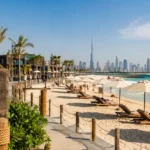

Why Palm Jumeirah Still Stops People in Their Tracks
Ask almost any resident of Dubai what they tell visiting relatives to see first and the answer is usually the same: the Palm. Not because it is the tallest or the oldest thing in the city, but because it is the one place that makes people stop talking for a second when they see it properly. A giant palm tree, drawn onto the sea, with hotels sitting on its rim like jewels on a bracelet.
That is Palm Jumeirah. It is a man-made island off the Jumeirah coast, sitting between Dubai Marina and the older beachfront districts, and it has become shorthand for everything Dubai wants to be known for: ambition, comfort, a little drama and a lot of sunshine. If you are researching Palm Jumeirah because you are planning a visit, thinking about a staycation, or just curious how a whole island ends up in the shape of a plant, this guide covers it without the brochure language.
I have organised it the way people actually plan: what the island is, whether you have to pay to enter, how to get there, what to do, where to stay, when to go, and what to avoid. There is a table or two to skim, a layout diagram, a temperature chart for picking your dates, and a set of frequently asked questions at the end.
What Is Palm Jumeirah?
Palm Jumeirah is the first of three palm-shaped islands that Dubai planned along its coast. The developer, Nakheel, began work in the early 2000s, and the island took shape through a process that sounds almost too simple: dredgers sprayed sand from the seabed in great arcs, a technique often called rainbowing, while GPS guided the placement so the fronds would come out in exactly the right place. Close to a hundred million cubic metres of sand went into it, plus a large quantity of rock to build the outer crescent that shields the island from waves.
The layout is easy to remember once you have seen the diagram below. A central trunk runs out from the mainland. Sixteen fronds branch off it, and they are lined with private villas, many with their own stretch of beach. Wrapped around everything is the crescent, a long curved breakwater. That is where you will find most of the big hotels, including Atlantis The Palm at the far tip. The trunk, meanwhile, is where the apartment towers, the malls and the monorail are.

The island at a glance: trunk for apartments and shopping, fronds for villas, crescent for hotels.
For the technical history, including coordinates and construction details, the Palm Jumeirah entry on Wikipedia is a reliable reference. What I want to focus on here is the practical side, the things the encyclopaedia does not tell you, like which end of the island is quiet on a Sunday morning and why you should never drive to the Atlantis end at six o’clock on a Friday.
Palm Jumeirah Quick Facts
| Detail | Information |
| Location | Jumeirah coast, Dubai, on the Arabian (Persian) Gulf |
| Address | Nakhlat Jumeira – Dubai – United Arab Emirates |
| Type | Man-made island, built by Nakheel |
| Area | About 5.72 sq km |
| Shape | A trunk, 16 fronds and a protective crescent |
| Entry | Free to enter and open to the public around the clock |
| Getting around | Car, taxi, ride-hailing, Palm Monorail, boat tours |
| Best months to visit | November to April |
| Known for | Atlantis resorts, beach clubs, The View at The Palm, luxury villas, sunset views |
| Name | Palm Jumeirah (Arabic: Nakhlat Jumeirah) |
| Developer | Nakheel |
| Getting there | Car, taxi, Dubai Tram plus Palm Monorail |
| Nearby | Dubai Marina, Jumeirah Beach Residence, Bluewaters Island |
Is Palm Jumeirah Free to Enter?
Yes. This is the question that confuses most first-time visitors, so it deserves a straight answer. There is no gate, no ticket and no entry fee for the island itself. You can drive on, walk the public areas, look at the hotels from outside, eat at the restaurants and take photographs at any hour. It is open to the public 24 hours a day.
What costs money is what sits on top of it. Think of the island as a public street and the attractions as shops along that street.
What you can do for free
- Walk or cycle along the Palm Jumeirah boardwalk, which runs for around 11 kilometres and gives long views back towards the Dubai skyline.
- Wander through hotel lobbies, which are often worth a look for the architecture alone.
- Spend an hour at Al Ittihad Park, one of the more relaxed green spaces on the island.
- Sit by the water at sunset. This costs nothing and is, honestly, the best part of the day.
- Browse the shops, cafes and restaurants at the malls and promenades.
What usually costs money
- Private beaches and beach clubs, which sell day passes or require a booking.
- Aquaventure Waterpark and other paid attractions at the Atlantis resort.
- The observation deck at The View at The Palm.
- The Palm Monorail, with a one-way fare of around 15 AED at the time of writing.
- Boat tours, kayak trips, helicopter rides and skydiving.
Prices change with the season and with demand, so always confirm on the operator’s own website before you set a budget.
How to Get to Palm Jumeirah and Get Around
Dubai International Airport is roughly 35 to 45 minutes away by road when traffic behaves, and longer when it does not. From most central areas, the easiest option is a taxi or a ride-hailing app. Both are plentiful, and the drivers know the island well, though it helps to give the name of the hotel or mall rather than just saying Palm Jumeirah.
If you prefer public transport, the usual route is the Dubai Metro Red Line to the Marina side, a switch onto the Dubai Tram, and then the Palm Monorail from Gateway station out to Atlantis. It is a longer journey than a taxi, but the monorail stretch is a good experience in its own right. For current timetables, fares and station information, check the Roads and Transport Authority website.
| Option | Best for | Notes |
| Taxi or ride-hailing | Most visitors, late nights | Door to door, simple, best for the crescent hotels and The Pointe |
| Private car | Families, flexible days | Parking is available at most venues, but evening traffic can be heavy |
| Palm Monorail | The view, reaching Atlantis | Runs along the trunk to Atlantis, fare about 15 AED one way |
| Metro, Tram and Monorail | Budget travellers | Longest option, but the monorail stretch has great views |
| Boat tour | Seeing the full shape | Departs mainly from Dubai Marina, scenic late in the day |
One honest note on the monorail: it is lovely and slow, and it runs only along the trunk to Atlantis. It is not a way to explore the fronds or the crescent. Many visitors use it for the view and then switch to a taxi for everything else.
A small tip about the view. Several people who have been will tell you that you cannot really see the palm shape from ground level, and that is correct. From the car it just looks like a very pretty, very wealthy island. To see the shape, you need height. That means the observation deck, a helicopter, a seaplane, or one of the boat tours from the water.
Best Things to Do on Palm Jumeirah
There is more here than a quick look at the map suggests. I have grouped these by the kind of day you might want.
See the whole island from above
The View at The Palm sits on the 52nd floor of the Palm Tower, about 240 metres up, and gives a full circle of views across the island, the Gulf and the city. It also has displays about how the island was built. If you only pay for one thing on the Palm, many people say this is the one. Go about an hour before sunset if you want daylight, golden light and city lights all in one visit.
Just above it, the AURA Skypool offers an adults-only infinity pool with a 360-degree outlook. It is popular, so booking ahead is sensible and dress codes apply.
Spend a day at Atlantis
Atlantis The Palm and its newer sister, Atlantis The Royal, are the two names most people associate with the island. Even without a room, there is plenty to see. Aquaventure Waterpark is among the largest in the region and suits families and thrill-seekers. The Lost Chambers Aquarium has large tanks and an underwater-ruins theme, and Dolphin Bay offers paid encounters with dolphins and sea lions. Entry to these is ticketed, while the public areas of the resort are generally open to walk through.
Take a boat out
The island looks different from the sea. Boat tours leave mostly from Dubai Marina and sail past Bluewaters Island, around the crescent and back, with views of Atlantis, Burj Al Arab and the Marina skyline along the way. Options range from large shared boats to smaller speedboat rides and private yachts. Late afternoon departures tend to give the best light.
Walk, cycle and eat along the water
The boardwalk along the trunk is where residents jog, cycle and walk dogs in the cooler months. Food trucks and cafes sit along parts of it, and the views back across the water to the skyline are the sort of thing you will end up photographing without meaning to.
The Pointe, at the tip of the trunk, is a waterfront dining and entertainment strip with views toward Atlantis. In the evening, the fountain show draws a crowd, and the restaurants fill up quickly at weekends. Palm West Beach, on the western side of the crescent, has a mix of casual and upmarket places to eat with the beach right there.
Shop and cool off
Nakheel Mall, at the base of the Palm Tower, has a mix of fashion, groceries and cafes, and it tends to be calmer than the giant malls on the mainland. It is a handy stop if the afternoon heat is catching up with you.
Do something adventurous
Skydive Dubai runs a drop zone on the Palm, with tandem jumps for first-timers, and the views on the way down are as dramatic as you would expect. Kayak and paddleboard tours leave from some of the resorts and give you a quieter, slower version of the island. Helicopter and seaplane flights are the premium options for seeing the full palm shape from above.
Palm Jumeirah Beaches
The beaches here are a mixture of private resort stretches, beach clubs with day passes, and a few public sections. The trunk side has some public access, but parking can be limited and the facilities simpler. Beach clubs on the crescent tend to offer pools, loungers, food and music, and many turn from a calm daytime spot into a livelier place after sunset.
If you are staying elsewhere in Dubai and want a beach day on the Palm, a day pass at a beach club or resort is the simplest option. Check whether the pass is redeemable against food and drink, whether children are welcome, and whether there are minimum spend rules at weekends.
Where to Stay: Palm Jumeirah Hotels at a Glance
Almost all hotels on the island are on the crescent or the trunk. The fronds are for private homes only. Here is a quick comparison of some of the best known names, with a note on who each tends to suit.
| Hotel | Style | Good for |
| Atlantis The Palm | Large themed resort with waterpark | Families, first-time visitors |
| Atlantis The Royal | Ultra-luxury, celebrity-chef dining | Special occasions, couples |
| Waldorf Astoria Dubai Palm Jumeirah | Quiet, elegant, refined | Relaxed luxury |
| Fairmont The Palm | Classic beachfront resort | Beach holidays, groups |
| Sofitel Dubai The Palm | French-inspired, calm | Couples, water sports |
| Jumeirah Zabeel Saray | Palace-style design, spa focus | Wellness, long stays |
| FIVE Palm Jumeirah | Social, party atmosphere | Friends, nightlife |
If it is your first visit, the simplest approach is to pick the style first, whether that is family resort, quiet luxury or social and lively, and then compare current prices. Rates swing a lot between peak winter weeks and the summer low season.
How Long to Allow for Each Stop
People tend to underestimate this island. The distances look short on a map but traffic, parking and queues add up. The chart below gives a rough idea of how much time each major stop takes.

Getting Around: Car, Tram, Monorail or Taxi
By car, take Sheikh Zayed Road and follow the signs for Palm Jumeirah. Driving lets you stop wherever you like, but evening traffic can be heavy, especially on weekends and holidays. Parking at hotels and malls is usually paid or validated.
The Palm Jumeirah Monorail runs from Palm Gateway at the base of the trunk to Atlantis at the crescent, with stops along the way. It is short, scenic and gives you the elevated view that a car cannot. You can reach Palm Gateway from Dubai Marina using the Dubai Tram, then switch to the monorail. Several visitors report that parking at Palm Gateway is free for the first few hours with a validated monorail ticket, though you should check current terms before relying on it.
Taxis and ride-hailing apps are plentiful. For a group of three or four, a taxi from Dubai Marina is often cheaper than the tram and monorail combined, and a lot quicker.
Living on the Palm: A Quick Look at Property
The Palm is one of the most recognised residential addresses in Dubai. Villas on the fronds are prized for private beach access and sea views, while apartments on the trunk and in the towers appeal to people who want to be close to the malls and the monorail. It is a prime waterfront market, which means prices and rents sit well above the city average.
If you are curious about how this area fits into the wider picture, it is worth reading up on broader Dubai property trends before making any decision, and comparing rents using a guide to the Dubai rental market. Anyone moving to the city for work should also look at the real cost of living in Dubai, because the Palm is at the top end of the scale. And if you are considering buying as an investment, this beginner’s overview of UAE property investment is a sensible place to start before you speak to an agent.
A caution that applies to every market: figures change quickly, so use current data from official sources such as the Dubai Land Department and verified agents.
Best Time to Visit Palm Jumeirah
Dubai is hot for a large part of the year, and that matters more on the Palm than elsewhere because so much of the fun is outdoors. The sweet spot runs from roughly November to April, when the days are warm but comfortable and the evenings are perfect for walking. From June to September it is very hot and humid, and most people move their plans indoors or to the water in the early morning and late evening.

Typical daytime highs by month. Plan outdoor activities around the green bars.
Two practical notes. First, weekends are busier, particularly Friday and Saturday evenings, and traffic towards the Atlantis end can slow to a crawl. Second, during Ramadan, eating and drinking in public places during daylight hours is discouraged, and opening hours at some venues change. Dress a little more modestly in public areas and keep swimwear for the beach and pool.
A Simple One-Day Plan
If you have just one day, this is a rhythm that works without wearing anyone out.
- Morning: breakfast near the trunk, then a walk along the boardwalk before the heat builds.
- Late morning: head to Nakheel Mall for some shade, a coffee and a quick look around.
- Afternoon: a beach club or hotel pool, or Aquaventure if you have children.
- Late afternoon: monorail or taxi to The View at The Palm in time for the sunset.
- Evening: dinner at The Pointe or Palm West Beach, and a slow walk to watch the lights.
Practical Tips From Experience
- Avoid the Atlantis end on Friday evenings if you can. Traffic is heavy and parking is slow.
- Book popular attractions and restaurants a few days ahead in the cooler months.
- Carry a light layer, because air conditioning inside malls and hotels can feel cold after the heat outside.
- Bring water and sun protection even for short walks. The sun here is stronger than it looks.
- Check the dress code at beach clubs and rooftop venues before you go.
- Use a taxi or ride-hailing app for the return trip at night, rather than relying on the monorail timetable.
Pros and Cons Of Visiting
| What works well | What to plan around |
| Spectacular sea and skyline views | Heavy traffic on weekend evenings |
| Free to enter, with lots of free walking space | Many attractions and beach clubs have a cost |
| Wide choice of hotels, restaurants and beaches | The palm shape is hard to see from ground level |
| Good for families, couples and groups | Summer heat limits outdoor time |
Palm Jumeirah FAQs
Where is Palm Jumeirah located?
Palm Jumeirah sits off the Jumeirah coast in Dubai, United Arab Emirates, near Dubai Marina and Al Sufouh. The address commonly used is Nakhlat Jumeira, Dubai. You can read the geographic and historical background on Wikipedia.
Is Palm Jumeirah free to visit?
Yes. Entry to the island is free and open 24 hours a day. You only pay for specific attractions such as Aquaventure, The View at The Palm, beach clubs and the monorail. See the section above on what is free and what is not.
How big is Palm Jumeirah?
The island covers about 5.72 square kilometres. It consists of a central trunk, 16 fronds and an outer crescent that acts as a breakwater.
How do I get to Palm Jumeirah without a car?
Take a taxi or ride-hailing app, or use the Dubai Metro, Dubai Tram and the Palm Monorail. Timetables and fares are published by the RTA.
How much is the Palm Monorail?
A one-way ticket was around 15 AED at the time of writing, and a return costs roughly double. Check the RTA website for current fares.
Can I visit Atlantis The Palm if I am not a hotel guest?
You can usually walk through public areas, dine at restaurants and book attractions such as Aquaventure separately. Details and ticket options are on the Atlantis Dubai website.
What is the best time of year to visit?
November to April is the most comfortable period, as the chart in this guide shows. Summer is possible, but plan for early mornings, evenings and indoor options.
Is Palm Jumeirah good for families?
Yes. Aquaventure, the beaches, the boardwalk and the aquarium all work well with children. Evenings can get crowded, so build in downtime.
Can I see the palm shape from the ground?
Not really. From road level it simply feels like a landscaped island. For the full shape, use the observation deck, a helicopter or seaplane flight, or a boat tour.
Is it expensive to stay on Palm Jumeirah?
It is among the pricier parts of Dubai, particularly in peak winter. Rates fall in summer. For wider planning, see Visit Dubai for official tourism information.
Final Thoughts
Palm Jumeirah is one of those places that gets talked about so much you wonder whether it can live up to it. It does, mostly, if you set your expectations correctly. It is not an old neighbourhood with centuries of stories. It is a modern, polished, slightly theatrical island that rewards you for choosing the right time of day and the right vantage point.
Go in the cooler months, see it from above at least once, leave time for a long slow dinner by the water, and do not try to fit everything into one day. And if you keep coming back, as many residents do, you will start to notice the quieter corners, the early morning boardwalk walkers and the empty stretches of beach, which are as good a reason to visit as any headline attraction.
Disclaimer
This guide is for general information only. Prices, opening hours, fares, access rules and attraction details can change without notice, so please confirm directly with the operator, hotel or official authority before you travel or spend money. Nothing here is financial, legal or investment advice. Property and rental information is general in nature and should be checked against current official data and a licensed professional.