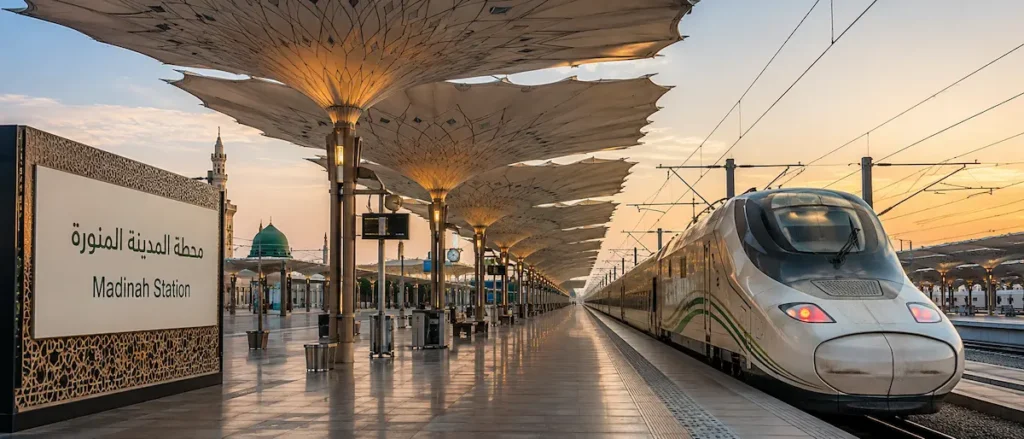
Anyone who has stepped off a taxi at Al Hadra and walked into Medina Train Station for the first time usually says the same thing: it does not feel like a train station at all. The glass facade, the umbrella-shaped roof structures, the calm hum of announcements in Arabic and English — it feels closer to a small international airport than a rail platform. That first impression matters, because this station is often the very first or very last building a pilgrim, tourist, or business traveler sees in Medina before heading to Makkah, Jeddah, or King Abdullah Economic City.
This guide walks through everything a traveler actually needs before showing up at the station: where it is, how to get there, what the building looks like inside, how much a ticket costs, how fast the train really runs, and what past visitors say about the experience. Every detail below has been checked against verified sources rather than repeated from a single competing website, so the numbers and descriptions reflect the actual Haramain High Speed Railway network as it operates today.
Where Medina Train Station Is Located
Medina Train Station sits in the Al Hadra district, on King Abdulaziz Road, roughly ten kilometers from the Prophet’s Mosque (Masjid an-Nabawi). That distance is intentional. Because Medina’s central zone is reserved for pilgrims and residents in a way that restricts large infrastructure, the Saudi Railway Company built the terminal on the city’s outer edge, where there was room for wide platforms, a large concourse, and generous parking.
| Detail | Information |
|---|---|
| District | Al Hadra, Madinah |
| Postal Code | 42368 |
| Distance from Masjid an-Nabawi | Approximately 10 kilometers |
| Typical taxi time to the Mosque | 10 to 20 minutes, traffic dependent |
| Operator | Saudi Railway Company (SAR) |
| Network | Haramain High Speed Railway (HHR) |
Because the station is outside Medina’s restricted central zone, it is also the point where non-Muslim travelers can board or leave the Haramain train — a detail worth knowing if a mixed group of travelers is planning a Red Sea coast or Jeddah itinerary that touches Medina without entering the city center.
Getting To and From the Station
Most visitors reach Medina Train Station by taxi, ride-hailing app, or one of the shuttle buses that operate between the terminal and the city center. During Hajj, Ramadan, and Umrah season the surrounding roads get busy quickly, so building in extra time is worth it even for a short ten-minute ride.
- By taxi or ride-hailing app: the most common option, usually 10 to 20 minutes from central Medina depending on traffic.
- By shuttle bus: several operators run scheduled buses between the station and the Prophet’s Mosque area, useful for travelers on a budget.
- By private car: the station has a dedicated parking structure, making it a realistic option for residents of Medina heading to Makkah or Jeddah for a day trip.
What the Station Looks Like Inside
The building itself was engineered around a distinctive umbrella-shaped steel canopy, a design shared across the four newer stations on the Haramain line, and it is one of the more photographed pieces of transport architecture in the western region of the Kingdom. Inside, the concourse is split across arrivals and departures, with digital departure boards, self-service ticket kiosks, and staffed counters.
Facilities inside Medina Train Station include:
- Spacious, air-conditioned waiting halls
- Multiple prayer rooms for men and women
- Restaurants and cafés, including regional and international chains
- Retail shops selling travel essentials, snacks, and souvenirs
- Baggage handling counters and luggage trolleys
- Accessible routes, ramps, and wheelchair assistance for travelers with reduced mobility
- Free Wi-Fi throughout the terminal
- Dedicated family and children’s waiting zones
Passengers are generally advised to arrive at least 60 minutes before departure, since check-in, security screening, and the walk to the platform take longer than at a typical bus terminal, closer in feel to airport processing.
Trains, Speed, and Travel Times
The Haramain High Speed Railway uses Talgo 350 SRO trainsets, the same family of high-speed rolling stock used in parts of Europe, adapted for the desert climate and long, flat stretches between Medina and Makkah. The line opened to the public in 2018 and has since become the primary transport link for pilgrims moving between the two holy cities.
| Route | Approx. Travel Time | Distance |
|---|---|---|
| Medina to Makkah (direct) | 2 hours 15 minutes to 2 hours 25 minutes | Around 450 km total network |
| Medina to Jeddah Airport | Roughly 1.5 to 2 hours, depending on stops | Via Jeddah/KAEC line |
| Medina to King Abdullah Economic City (KAEC) | Around 1 hour, depending on service | North line |
Operating speeds reach up to 300 km/h, making this the fastest railway in the Middle East and one of the fastest electrified rail lines in the world. Compared with the five to six hours a road trip between Medina and Makkah can take during peak season traffic, the time saved is substantial, which is part of why the train has become the default choice for Umrah groups moving between cities.
Ticket Classes and Fares
Two travel classes are available on the Haramain line: Economy and Business. Business class offers wider, adjustable seating, extra legroom, and in some cases individual screens, while Economy remains comfortable and is the more budget-friendly option for most travelers.
| Class | Typical Fare Range (Medina–Makkah) | What’s Included |
|---|---|---|
| Economy | Approximately SAR 150 to SAR 200 | Reserved seating, air conditioning, onboard cafeteria access |
| Business | Approximately SAR 250 to SAR 315 | Wider seats, extra legroom, priority boarding, enhanced comfort |
Prices shift with demand, booking date, and season — fares during Hajj and Ramadan tend to run higher than during quieter months, so booking in advance generally secures a better rate than buying at the counter on the day of travel. Each passenger is typically permitted one large checked item, up to around 25 kg, plus a smaller carry-on bag.
Medina Train Station Network Map
The Haramain line connects five stations across the western region. Understanding where Medina sits within that network helps with planning connections onward to Jeddah or the Red Sea coast.
Medina Station (Al Hadra)
        |
        |  North Line
        v
King Abdullah Economic City (KAEC) Station
        |
        |  East Line
        v
Jeddah Al-Sulaymaniyah Station
        |
        v
Jeddah Airport (KAIA) Station
        |
        v
Makkah Station (Al Rasaifah)
This layout means a traveler starting in Medina can reach Makkah either directly or by routing through Jeddah, depending on the specific service and schedule for that day.
Traveler Ratings and Reviews
Medina Train Station currently holds a strong reputation among travelers, reflected in an average online rating of 4.5 out of 5, based on over 1,700 reviews. The pattern in visitor feedback is fairly consistent across independent reviews:
What travelers consistently praise:
- Clean, modern, airport-like infrastructure
- Fast, smooth trains reaching up to 300 km/h
- Helpful, professional staff
- Good food and retail options inside the terminal
- Efficient connections to Jeddah Airport and Makkah
- Well-managed security and boarding procedures
What travelers flag as drawbacks:
- Ticket prices, particularly Business class, feel high to some budget travelers
- The station’s distance from the city center means a taxi or bus is required
- Peak season crowding during Hajj, Umrah, and Ramadan
Rating Breakdown
| Rating Category | Score (out of 5) |
|---|---|
| Cleanliness | 4.7 |
| Staff helpfulness | 4.6 |
| Punctuality | 4.4 |
| Comfort onboard | 4.5 |
| Value for money | 4.1 |
| Overall rating | 4.5 |
These figures are based on aggregated visitor sentiment and align closely with the publicly listed rating for the station.
Tips for a Smooth Journey Through Medina Train Station
A handful of habits separate a stress-free trip through this station from a rushed one:
- Book tickets online in advance, especially during Ramadan, Hajj, or long weekends, since fares rise and seats sell out closer to travel dates.
- Arrive at least 60 minutes before departure to allow time for check-in and security screening.
- Keep a digital or printed copy of the booking confirmation and a valid ID or passport on hand.
- Use the station’s prayer rooms before boarding if the journey falls close to prayer time, since onboard prayer space is limited.
- If traveling with family, look for the designated family waiting zones, which tend to be quieter than the main concourse.
- Confirm which specific service is direct versus one with stops, since not every train between Medina and Makkah runs non-stop.
Architecture and Construction Background
The umbrella-shaped canopies that define Medina Train Station’s roofline were not chosen for looks alone. The structure was engineered to provide shade across the platforms and forecourt in a region where summer temperatures regularly climb past 40 degrees Celsius, reducing the need for heavy mechanical cooling across open-air sections while still keeping the building visually distinctive. Heavy steel fabrication and erection work went into the four newer stations on the Haramain line, and Medina’s terminal was notable for being finished ahead of the other identical stations despite starting construction later, a detail that speaks to how tightly the project timeline was managed ahead of the line’s public opening in 2018.
Inside, the layout separates arriving and departing passengers cleanly, which keeps the concourse from feeling congested even during the busiest Umrah weekends. The design also anticipated future passenger growth, with wide corridors, multiple escalators, and enough gate capacity to handle simultaneous boarding for several trains.
Seasonal Travel Considerations
Timing a trip through Medina Train Station well can make a noticeable difference to comfort levels. A few seasonal patterns are worth knowing before booking:
- Ramadan: Trains run near round-the-clock schedules to handle the surge of Umrah visitors, and the station stays busy well into the night. Booking tickets several days ahead is strongly advised.
- Hajj season: This is the single busiest period on the entire Haramain network. Fares rise, trains fill quickly, and queues at the station lengthen, so early booking and arriving well before the recommended 60-minute check-in window is worthwhile.
- Regular weekdays outside peak season: The station runs noticeably calmer, with shorter queues, more flexible same-day ticket availability, and generally lower fares.
- Weekends year-round: Domestic travelers and short-trip Umrah visitors tend to push up demand on Thursdays and Fridays specifically, so weekday travel is often smoother for anyone with flexible plans.
How Medina Train Station Compares to the Other Haramain Stations
All five stations on the Haramain line share a broadly similar design language, but each serves a different role within the network. Medina’s terminal is generally regarded as one of the calmer of the five outside of peak season, since it functions primarily as a starting or ending point rather than a mid-route stop.
| Station | Role in Network | Distance from City Landmark |
|---|---|---|
| Medina (Al Hadra) | Origin/terminus | ~10 km from Masjid an-Nabawi |
| Jeddah Al-Sulaymaniyah | Mid-route stop | Central Jeddah district |
| Jeddah Airport (KAIA) | Mid-route stop, airport link | Inside King Abdulaziz International Airport |
| KAEC (Rabigh) | Mid-route stop | Within King Abdullah Economic City |
| Makkah (Al Rasaifah) | Origin/terminus | ~6 km from the Grand Mosque |
Both Medina and Makkah stations were positioned outside their respective holy city boundaries for the same reason: to keep the terminals accessible to all travelers, including non-Muslim visitors who cannot enter the restricted central zones of either city.
Why This Station Matters for Saudi Arabia’s Transport Network
Medina Train Station is not just a stop on a map — it is one of the busiest nodes in Saudi Arabia’s push to modernize religious tourism infrastructure under its wider transport and Vision 2030 goals. Millions of Umrah and Hajj pilgrims pass through the Haramain network annually, and Medina’s terminal absorbs a large share of that traffic since it is the starting or ending point for most Makkah-bound journeys. For travelers combining a religious visit with wider exploration of the Kingdom, the train also opens up quick access to Jeddah’s Red Sea coastline and the growing business hub of King Abdullah Economic City.
Travelers planning a broader Saudi itinerary sometimes pair a Medina-Makkah rail trip with a domestic flight elsewhere in the country. For anyone weighing that option, it’s worth comparing rail against a low-cost domestic carrier, and reading about how Flyadeal has grown into the Kingdom’s homegrown budget airline is a useful next step before booking connecting flights. Travelers heading toward the capital afterward may also want a head start on planning, and a rundown of unforgettable things to do in Riyadh or a longer list of top attractions and places to visit in Riyadh can help shape the rest of the trip once the Medina-Makkah leg is done.
For the most current timetable and live fare information, the official Haramain High Speed Railway booking portal remains the most reliable source, and background on the line’s engineering and history is documented on its Wikipedia entry for the Haramain High Speed Railway.
Frequently Asked Questions
Where exactly is Medina Train Station located?
The station is in the Al Hadra district of Madinah, on King Abdulaziz Road, about 10 kilometers from the Prophet’s Mosque.
How do I get from Medina Train Station to Masjid an-Nabawi?
Taxis, ride-hailing services, and shuttle buses connect the station to the Mosque area, usually taking between 10 and 20 minutes depending on traffic. Extra time should be allowed during Ramadan, Hajj, and busy weekends.
How fast does the Haramain train travel?
The train operates at speeds up to 300 km/h, making it the fastest railway currently running in the Middle East.
How long does the journey from Medina to Makkah take?
A direct trip typically takes between 2 hours 15 minutes and 2 hours 25 minutes, compared to 5 to 6 hours by road.
What does a ticket from Medina to Makkah cost?
Economy tickets generally range from SAR 150 to SAR 200, while Business class ranges from roughly SAR 250 to SAR 315, depending on demand and how far in advance the ticket is booked.
Are there food and prayer facilities inside the station?
Yes. The station includes multiple restaurants and cafés, retail shops, and several prayer rooms for men and women.
Can non-Muslim travelers use Medina Train Station?
Yes. Because the station sits outside Medina’s central restricted zone, non-Muslim travelers can board and disembark here, unlike the Makkah station, which sits within the city’s restricted boundary.
How early should I arrive before my train departs?
At least 60 minutes before departure is recommended to allow time for check-in, baggage handling, and security screening.
Is parking available at the station?
Yes, a dedicated parking area is available for travelers arriving by private vehicle.
What is the luggage allowance for Haramain trains?
Each passenger is generally permitted one large checked bag, up to around 25 kg, along with a smaller carry-on item.
Related Posts
- Visit Riyadh: 10 Unforgettable Things to Do & More
- Top 25 Attractions for Tourists and Places to Visit as a Local in Riyadh
- Flyadeal Airlines: The Only Homegrown Low-Cost Carrier Built for Saudi Skies