
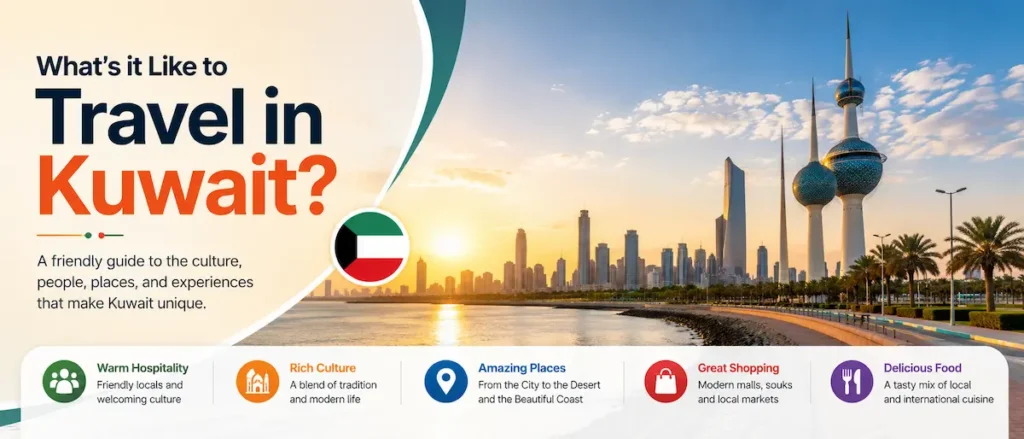
Kuwait rarely shows up on anyone’s Gulf shortlist. Travelers heading to the Middle East tend to book Dubai, Doha or Muscat first, and Kuwait gets left as an afterthought, a country people fly through rather than fly to. That reputation is only half fair. Kuwait is not a destination built around tourist attractions, and it never pretends to be one.
What it offers instead is something closer to real life: a small, wealthy, oil-funded city-state where the malls are enormous, the desert starts the moment the buildings stop, and almost nobody around you is a tourist. If you go in expecting a checklist of landmarks, you will be disappointed. If you go in curious about how a country lives when it has never needed tourism revenue, Kuwait is genuinely interesting.
This guide covers what a trip to Kuwait actually looks like on the ground: visas, transport, costs, culture, the best areas to explore, and the honest trade-offs of visiting a country that was never designed with visitors in mind.
Kuwait at a Glance
| Category | Details |
| Capital | Kuwait City |
| Language | Arabic (English widely spoken in hotels, malls and tourism) |
| Currency | Kuwaiti Dinar (KWD) — one of the highest-valued currencies in the world |
| Best time to visit | November to March |
| Visa | E-visa available online for most nationalities |
| Alcohol | Illegal to import, sell or consume |
| Getting around | Ride-hailing apps (Careem) or a rented car |
| Typical trip length | Two to three days |
Getting Into Kuwait
Most visitors fly into Kuwait International Airport, a short ride from the city center. E-visas can be applied for online ahead of time and are generally processed within a day, which is worth doing rather than relying on arrival visas, since immigration queues at the airport can run long during peak hours. Once the visa is approved, entry itself is usually straightforward: a stamp, a quick bag check, and you are through.
Kuwait does not operate like a country trying to sell itself to arriving passengers. There is no tourism desk pushing city tours, no rack of glossy brochures. You are, in a very real sense, on your own from the moment you land, which sets the tone for the rest of the trip.
Getting Around: Why You Will Need a Car or a Ride-Hailing App
Kuwait City is not a walking city. Distances between attractions are long, pavements are inconsistent, and summer heat makes any outdoor walk beyond a few minutes uncomfortable for most of the year. Almost every visitor ends up relying on Careem, the region’s dominant ride-hailing app, or a rented car for longer day trips outside the city.
Fares are reasonable by Gulf standards, and drivers know the main landmarks well even when addresses themselves are vague. If you are combining Kuwait with a wider Gulf itinerary, it is worth comparing how differently cities like Dubai are laid out. Readers planning a longer regional stretch may find it useful to look at how far apart attractions sit along Sheikh Zayed Road in Dubai before deciding how much driving time to budget for each leg of the trip.
What Kuwait Actually Feels Like as a Destination
This is the part most guides avoid saying directly: Kuwait does not try to entertain you. There is no tourism board actively marketing the country, no push to build attractions purely for visitors, and very little infrastructure aimed at foreign travelers outside of hotels and airport services. Locals shop, eat and socialize largely indoors, in malls and cafes, which is a rational response to a climate that turns hostile for roughly half the year.
What this means for a visitor is that Kuwait rewards a slower, more observational style of travel rather than a sightseeing sprint. The Gulf’s older maritime and pearl-diving history, the contrast between towering modern architecture and quiet fishing harbors, and the sheer scale of everyday consumer culture are all genuinely worth seeing. They are just not packaged the way attractions in more tourism-driven cities are. Travelers used to walkable historic centers will need to recalibrate expectations here.
Best Time to Visit Kuwait
Kuwait has one of the harshest climates in the region, and timing a trip well makes an enormous difference to how enjoyable it is. The chart below shows how sharply temperatures shift across the year in Kuwait City.
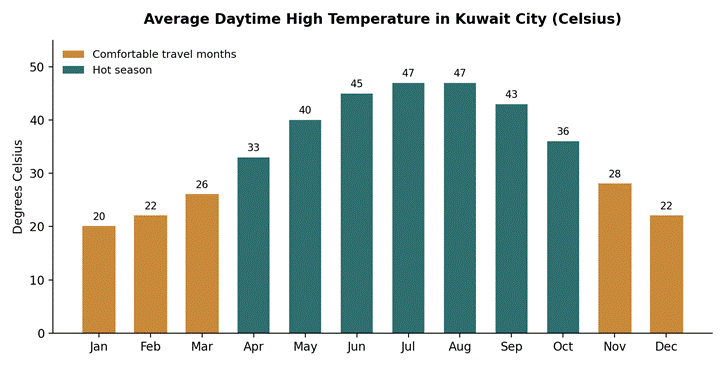
Between November and March, daytime temperatures typically sit in a comfortable range, making outdoor exploration realistic. From May through September, highs regularly climb past 45 degrees Celsius, and Kuwait has recorded some of the highest temperatures ever measured in Asia. Visiting during summer is possible, but it will mean shifting almost every outdoor activity to early morning or after sunset, and spending the middle of the day in malls or museums.
Money, Costs and the Kuwaiti Dinar
The Kuwaiti Dinar is consistently ranked among the highest-valued currencies in the world, which catches a lot of first-time visitors off guard. Prices that look modest in dinar terms convert to noticeably higher amounts in dollars, euros or pounds, so it is worth doing the mental conversion before assuming something is cheap.
Overall, Kuwait sits in a similar cost bracket to other wealthy Gulf states. Hotels, dining out and private tours can be expensive, particularly during the hotter months when rates rise, but everyday costs like public transport, street food and casual meals remain reasonable. Budget travelers have fewer options than in Dubai or Doha simply because Kuwait has very little backpacker-oriented infrastructure, but a mid-range trip is very manageable.
Culture, Dress Code and Local Customs
Kuwait is a conservative Muslim country, and the culture reflects that in ways every visitor should plan around before arriving.
- Alcohol is illegal to import, buy or drink publicly, and penalties for breaking this rule are serious.
- Modest dress is expected in public: shoulders, chest and knees covered for women, and knee-length shorts or trousers for men in most settings.
- Public displays of affection beyond holding hands are best avoided.
- Some hotels ask unmarried couples for proof of marriage before allowing a shared room, so it is worth checking a hotel’s policy directly.
- Friday and Saturday form the weekend, which affects opening hours for mosques, government buildings and some attractions.
None of this makes Kuwait unwelcoming. In practice, most visitors report that locals pay them little attention, and solo travelers, including solo women, generally describe Kuwait as one of the calmer countries in the region to explore. A helpful outside perspective on how this compares with attitudes elsewhere in the Gulf can be found in this Quora thread from people who grew up in Kuwait, which offers a locals’-eye view rather than a visitor’s.
Where to Spend Your Time in Kuwait
Kuwait Towers.
The most recognizable landmark in the country, with a rotating viewing platform inside one of the spheres offering wide views over the coastline and city skyline.
Al Shaheed Park.
One of the largest green spaces in Kuwait City, with walking trails, water features, a botanic garden and two small museums. It is consistently the spot most visitors mention as the most relaxing part of their trip.
Souk Al Mubarakiya.
A market that has operated for well over a century, selling spices, gold, textiles, dates and traditional Kuwaiti sweets. It is one of the few places in the city that still feels distinctly local rather than built for shoppers.
The Grand Mosque.
Kuwait’s largest mosque offers free guided tours a few times a day, giving visitors a rare, structured introduction to Islamic architecture and practice in the country.
Failaka Island.
Reachable by ferry, Failaka mixes ancient ruins dating back thousands of years with recent history: abandoned buildings and military remnants left over from the Gulf War. It is one of the more genuinely unusual half-day or full-day trips available anywhere in the Gulf.
The Avenues Mall and other shopping centers.
Shopping is a core part of daily life in Kuwait, and the scale of malls here rivals anything in the region. For travelers who enjoy people-watching and understanding local consumer culture, an afternoon here says more about modern Kuwait than most formal attractions do.
If shopping-driven city culture interests you, it is worth comparing this against how other Gulf cities blend green space with modern development. The way Khalifa Park in Abu Dhabi balances landscaped park space against a dense urban backdrop offers a useful point of comparison for travelers building out a longer Gulf itinerary.
Food Worth Trying
Kuwaiti cuisine draws heavily on Gulf, Persian and South Asian influences. Machboos, a spiced rice dish usually served with chicken, lamb or fish, is close to the national dish and worth trying at a local restaurant rather than a hotel buffet. Fresh dates, strong cardamom-spiced coffee, and grilled seafood pulled straight from the Gulf waters are all worth seeking out, particularly around the older fishing harbors where the catch is sold each morning.
Where to Stay
Most visitors base themselves in or near Kuwait City, close to Sharq or Salmiya, both of which offer easy access to the main sights, restaurants and the waterfront. Hotel options range from a small number of budget hostels to well-reviewed mid-range and international five-star properties. Given the heat for much of the year, a hotel with a pool and strong air conditioning is worth prioritizing over one that is marginally closer to a specific attraction.
Is Kuwait Safe to Visit
Kuwait is consistently rated as one of the safer countries in the Middle East for travelers, including solo travelers. Violent crime against visitors is rare, and the main practical risks come from road safety, since traffic can be fast and aggressive, rather than personal security. Standard travel precautions apply, but Kuwait does not require the heightened caution some other regional destinations do. For broader background on the country’s geography, history and governance beyond what a travel guide covers, Kuwait’s Wikipedia entry is a reliable starting point.
A Simple Two to Three Day Structure
Most visitors find two full days enough to cover Kuwait City itself, with a third day set aside for Failaka Island or a desert excursion if time allows. A loose structure that works well:
- Day one: Kuwait Towers, Al Shaheed Park and Souk Al Mubarakiya, finishing with dinner near the waterfront.
- Day two: The Grand Mosque tour in the morning, followed by a museum or cultural center, then an afternoon at one of the major malls.
- Day three (optional): A ferry trip to Failaka Island, or a half-day desert tour if you would rather stay closer to the city.
Travelers extending their trip into the wider Gulf often continue on to the UAE afterward. If Dubai is next on the itinerary, it is worth reading up on lower-key spots such as Kite Beach in Dubai or the quieter green space at Quranic Park as a contrast to Kuwait’s more low-key public spaces.
Final Thoughts
Kuwait is not going to compete with Dubai or Doha for polish, and it was never trying to. What it offers instead is a more grounded look at Gulf life: malls instead of theme parks, working fishing harbors instead of curated waterfronts, and a level of quiet that is increasingly hard to find elsewhere in the region. Go in with realistic expectations, plan around the heat, and Kuwait turns out to be a country worth the two or three days most visitors give it.
Frequently Asked Questions
Is Kuwait worth visiting as a tourist?
Kuwait is worth visiting for travelers interested in the Gulf region, Islamic architecture, desert landscapes and a country that has largely stayed outside mainstream tourism. It is not a destination built around a long list of major attractions, so it suits curious, flexible travelers more than those seeking a packed sightseeing itinerary.
How many days do you need in Kuwait?
Two to three days is generally enough to see the main sights in Kuwait City and take a day trip to Failaka Island. Longer stays make more sense if combined with business travel or a wider Gulf itinerary.
Do you need a visa to visit Kuwait?
Most nationalities can apply for an e-visa online before arrival, which is faster and less stressful than applying on arrival at the airport.
Can you drink alcohol in Kuwait?
No. Kuwait is a dry country, and importing, buying or publicly consuming alcohol is illegal, with serious penalties for violations.
What should you wear in Kuwait as a visitor?
Modest clothing is expected. Women should aim to cover shoulders, chest and knees, and men should avoid very short shorts or sleeveless tops in public and religious sites.
Is Kuwait expensive to visit?
Kuwait sits in a similar price bracket to other wealthy Gulf states. The strong Kuwaiti Dinar can make prices look deceptively low at first glance, so it is worth converting costs carefully before booking.
What is the best time of year to visit Kuwait?
November through March offers the most comfortable weather for outdoor exploration. Summer months bring extreme heat that limits daytime activity considerably.
Disclaimer: This guide is intended for general informational purposes only. Prices, visa rules, opening hours and travel regulations in Kuwait can change without notice, so always verify current requirements with an official Kuwaiti government source or your nearest Kuwaiti embassy before booking travel. This article does not constitute legal, immigration or professional travel advice.